junger Level magic d06 Manual de usuario

2ch digital audio leveller
d06
LEVEL MAGIC™


O
p
eration manual do6, cha
p
ter 1
–
Content
–
p
a
g
e 1 of 4
FOREWORD
Thank you for buying and using the 2-channel Digital Audio Level Processor
d06.
You have acquired the latest generation of digital dynamic range processing
and also a piece of equipment which is unique in its design and
specification.
Please read this manual carefully to ensure you have all the information you
need to use the 2 - channel Digital Audio Level Processor d06.
The unit was manufactured to the highest industrial standards and went
through extensive quality control checks before it was supplied.
If you have any comments or questions about installing, setting-up or using
the d06, please do not hesitate to contact us.
1

O
p
eration manual do6, cha
p
ter 1
–
Content
–
p
a
g
e 2 of 4
CONTENT
2. Function description
2.1 Basic description
2.2 Block diagram
2.3 Audio signal processing
2.3.1 Gain
2.3.2 Audio Leveler Level Magic™
2.3.3 Limiter
2.4 The Jünger Audio Dynamics Principle
2.4.1 Program
2.4.2 Influence of signal delay time
3. Installation
3.1 Unpack the unit
3.2 Power supply
3.3 Connections
3.4 Rack mounting
3.5 Operation safety
3.6 Synchronization the digital output
3.7 Rear panel connectors
3.7.1 Audio connections
3.7.2 GPI
3.7.3 GPO (tally)
3.7.4 Serial RS422 or RS232 or CAN
3.7.5 LAN ( Ethernet)
3.8 Switches and jumpers for configuration
3.8.1 Selection of the serial remote interface
3.8.2 Calibration of the analog inputs and outputs

O
p
eration manual do6, cha
p
ter 1
–
Content
–
p
a
g
e 3 of 4
4. Network integration
5. Operation
5.1 GUI operation
5.1.1 Setting the d06 parameters
5.1.2 Setup the device
5.1.3 General settings
5.1.4 Preset operation
5.1.5 GPI/O set up
5.1.6 LAN Controller set up
5.1.6.1 System Configuration
5.1.6.2 Backup 6 restore
5.1.6.3 Software update
5.1.6.4 Reboot the LAN Controller
5.2. Front Panel Operation (optional)
5.2.1 Setting the reference levels
5.2.2. Menu selection
5.2.3. Preset menu
5.2.4. Configuration menu
5.3.5. Parameter menu
6. Technical specifications
7. Warranty and service information
8. CE Declaration of Conformity

O
p
eration manual do6, cha
p
ter 1
–
Content
–
p
a
g
e 4 of 4

2. FUNCTIONAL DESCRIPION
operation manual d06, chapter 2 - Functional Description - page 1 of 8
FUNCTIONAL DESCRIPTION
The digital dynamics processor d06 is a professional studio device that is
performing automated levelling of digital audio signals.
The dynamic range processor principles developed by Jünger Audio enable
level managing devices like compressors, AGC and limiters to be produced
with exceptionally high audio quality, without coloration, pumping, breathing,
distortion or modulation effects sometimes associated with this type of
processor.
In short, almost inaudible processing - with ease of use. The outstanding
quality of the processing is based on the Multi-Loop dynamic range control
principle in combination with adaptive controlled processing algorithms
developed by Jünger Audio.
The unit is easy to operate and requires only a limited number of settings to
be made by the user to achieve optimum results. All other parameters
necessary for inaudible processing are continuously automatically controlled
in response to changes in the programme signal.
features
• 2-channel digital audio levelling processor
• various link modes: stereo 1/2 or ch1 and ch2 independent
• adjustable input gain (channel independent) -20...+20 dB
• adaptive controlled audio levelling processing
- Leveler, Transient Processor, Limiter
• user friendly preset and recall function (10 presets)
• extern sync mode, AES/EBU, WCLK or VIDEO
• RS-232/422 interface for serial remote
• GPI interface for parallel remote control, tally output
• operation via web interface (LAN)
• optional operation via front panel
2.1
BASIC
DESCRIPTION
2

2. FUNCTIONAL DESCRIPTION
operation manual d06, chapter 2 - Functional Description - page 2 of 8
2.2
BLOCK
DIAGRAM

2. FUNCTIONAL DESCRIPION
operation manual d06, chapter 2 - Functional Description - page 3 of 8
All signal processing is done in the digital domain by Texas Instruments
floating point signal processors. The use of 32 bit word length for calculation
ensures that there is no deterioration in signal quality, even if an audio signal
with a maximum word length of 24 bit is input into the processing of the unit.
GAIN means linear amplification of input signals. The input gain can be
changed in steps of 0.1 dB , within a range from -20...+20 dB for both
channels.
Level Magic ™ is a unique algorithm to make automated audio levelling
possible.
2.3
AUDIO SIGNAL
PROCESSING
2.3.1
GAIN
2.3.2
AUDIO LEVELLER
LEVEL MAGIC™
AGC
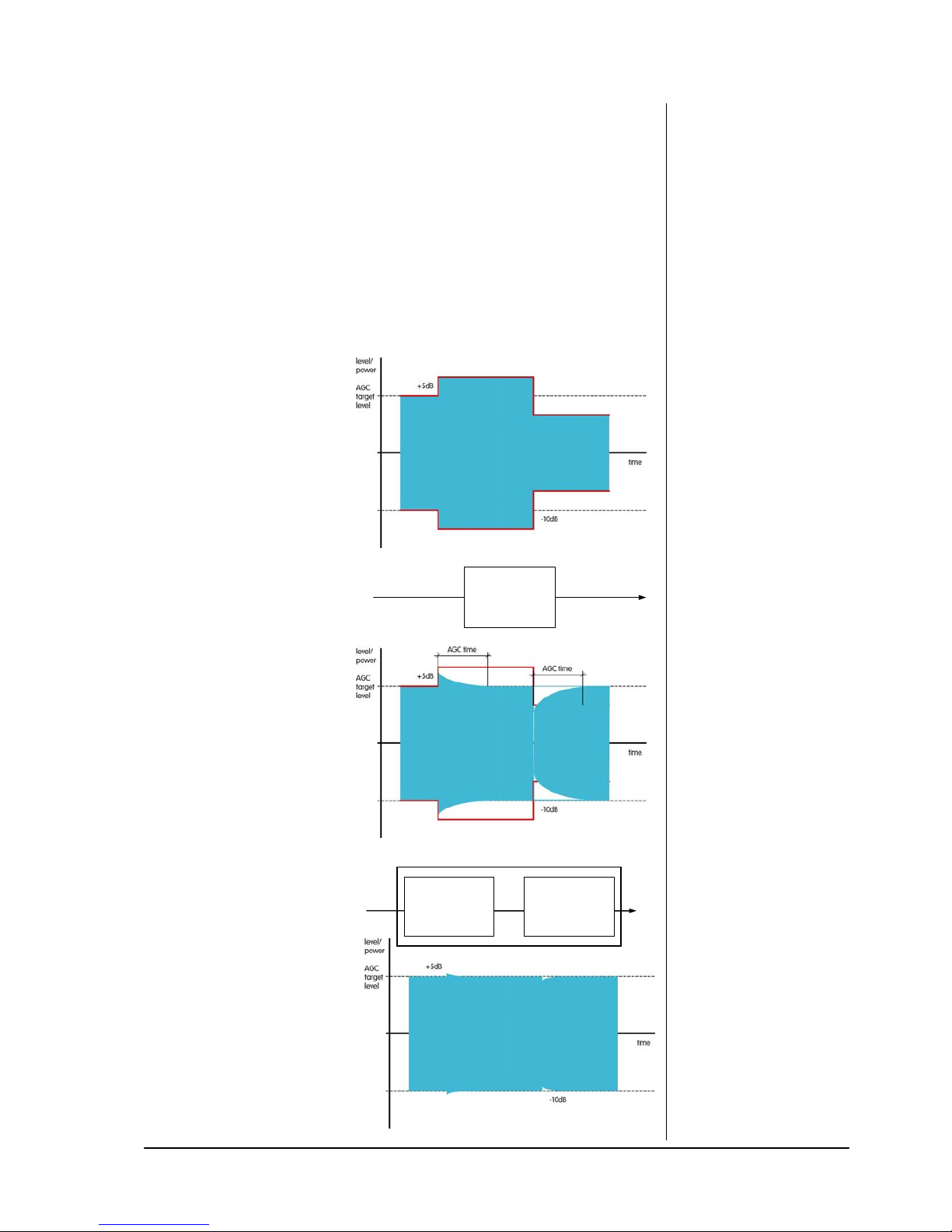
Input level change
Pic. 2 is showing a
theoretical level change of
+5dB and –5dB around
program level.
Working with AGC
In pic.3 a conventional
AGC is used to adjust the
level. As we can see the
AGC needs a certain time
to react, that is necessary
for mostly inaudible gain
correction. But that’s too
long to get a proper
correction of the input level
change.
Level Magic ™
Level Magic ™ is a unique
combination of a transient
processor and an adaptive
AGC process. The
transient processor can fill
the lack of level control
against the slow acting
AGC. The total gain of
Level Magic ™ is the
addition of the gain by the
transient processor and the
gain of the AGC.
adaptive
AGC
Transient
Processor

2. FUNCTIONAL DESCRIPTION
operation manual d06, chapter 2 - Functional Description - page 4 of 8
The Level Magic ™ process needs to be setup in three steps
-select one of the default presets for your apllication
(see preset description in chapter 5)
-adjust the operation level and peak level referring to standards that
are used for your application
-if the default preset is not giving satisfying results change the
parameters indivdually
Level Magic ™ is using a unique combination of QP and RMS level detectors
to analyze the incoming audio signal. By comparing QP and RMS
measurement results we can find out how much transients are coming in.
Dependent on that the necessary resulting gain is controlled in relation
between transient processor and AGC.
Transient processor is doing fast gain change and the AGC is doing slow gain
change (depending on settings). The way how Level Magic is acting on the
audio is mostly determined by balancing between slow and fast gain changing
process. The AGC should be set in a way that the gain change is mostly
inaudible (1dB per 5 seconds or slower). The Transient Processor should be
set that incoming level jumps are reduced but originally dynamic range is not
changed too much. As more possible gain by the Transient processor
(RANGE), as more reduction of the dynamic range will be.
SOFT level control: AGC range …15dB, time >=2min
Transient range …4dB, soft process
MID level control: AGC range …12dB, time >=1min
Transient range …6-8dB, mid process
HARD level control: AGC range …10dB, time >=40sec
Transient range …10dB, hard process
Parameter description:
AGC
OP-level operation level, target level for the AGC and for
the Transient Processor
Range max. gain by the AGC
Time time to reach the max. gain change
Gate threshold level where the AGC stops gain
change and moves gain slowly to the long
term average gain
Transient Processor
Process a combination of level ratio and release
characteristic for the fast gain change (soft, mid,
hard)
Range max. level change by the Transient Processor
Adjustment
procedure
Process
description
Parameter
description
Transient
Processor
AGC
Level
Detection
Limiter
Este manual sirve para los siguientes modelos
2
Tabla de contenidos
Otros manuales de Equipo de grabación de junger
Manuales populares de Equipo de grabación de otras marcas

Strymon
Strymon NIGHTSKY Manual de usuario

Mitsubishi Electric
Mitsubishi Electric 16CH DIGITAL RECORDER DX-TL5000U Manual de usuario

Tews Technologies
Tews Technologies TPMC465 Manual de usuario

Honeywell
Honeywell Excel 50 Manual de usuario

SeaLevel
SeaLevel COMM+8.LPCI Manual de usuario

Arturia
Arturia AUDIOFUSE STUDIO Manual de usuario