5
Your Jericho battery will be shipped to you in a partially discharged state. You may wish to charge the
battery before first use, but it is not necessary. There is no break-in or other special procedure to follow
when first using the battery.
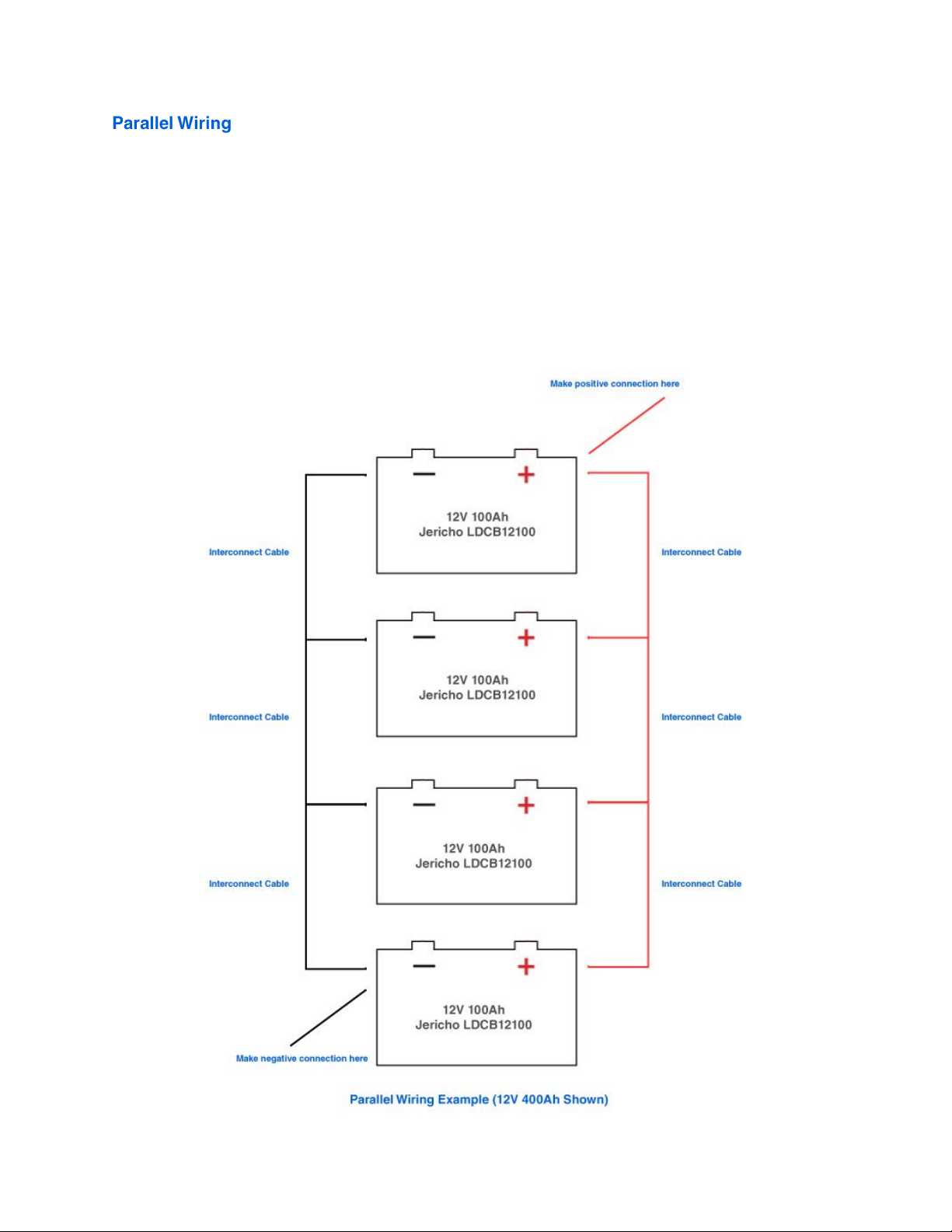
There are other ways to wire battery banks than just series and parallel, including series-parallel
configurations and by using buss bars or other combiner methods. However, the Jericho LDCB12100 can
only be used in a series configuration or parallel configuration with a maximum of 4 batteries. In other
words, up to 4 Jericho batteries can be wired in series to form up to a 48V battery bank OR up to 4
Jericho batteries can be wired in parallel to form up to a 400Ah battery bank (at 12V). Series-parallel
configurations and other methods are not recommended and not supported.
As mentioned above, when operating a battery bank in series, it is best to pull the battery bank apart
once per year (or more often if the system is used daily) and charge each battery to full, individually,
with a supported lithium battery charger. See the charging section of this manual for proper charging
parameters and settings. Then, after charging each battery to full, individually, re-connect them in the
series bank in a different order than they were previously connected. This rotation helps to make sure
that one battery is not stressed more than another, causing the batteries to drift apart over time.
When operating a battery bank in parallel, it is not as necessary to pull the batteries apart and charge
and rotate them.
When installing your battery in a boat, in an exterior compartment of a recreational vehicle, or any
other location where the battery may come in contact with water, it is best to install it inside of a
battery box, bulkhead, or other compartment that prevents submersion or sustained contact with
water. The battery is water resistant but not waterproof. A quick, accidental splash should not harm
the battery, although it should be protected against as much as possible. But if the battery gets rained
on or comes in contact with big waves or sustained jets of water, it will most likely be damaged.
Make sure to tighten battery leads to the battery terminals with around 10 foot-pounds of torque.
Always use a properly rated DC fuse or breaker in between the battery and the load(s), such as an
inverter.