iPower SUWP50 Manual de usuario

WATER PUMP OPERATION INSTRUCTION
THIS MANUAL CONTAINS IMPORTANT INFORMATION REGARDING SAFETY, OPERATION, MAINTENANCE
AND STORAGE OF THIS PRODUCT. BEFORE USE, READ CAREFULLY AND UNDERSTAND ALL CAUTIONS,
WARNINGS, INSTRUCTIONS AND PRODUCT LABELS. FAILURE TO DO SO COULD RESULT IN SERIOUS
PERSONAL INJURY AND/OR PROPERTY DAMAGE
10/2014 0201100_A

Thank you for purchasing a water pump.
This manual covers the operation and maintenance of water pump
The information and specifications included in this publication were in effect at
the time of approval for printing.
No part of this publication may be reproduced without written permission.
This manual should be considered a permanent part of the pump and should
remain with the pump if it is resold.
The illustration may vary according to the type.
Keep this owner’s manual handy, so you can refer to it at any time. This owner’s
manual is considered a permanent part of the water pump and should remain
with the water pump if resold.
If a problem should arise, or if you have any questions about the pump, consult
you authorized dealer.

2
CONTENTS
1. PUMP SAFETY ………………………………………………………………….. 3
2. COMPONENTS & CONTROL LOCATIONS ………………………………… 5
3. CONTROLS …………………………………………………...…………………6
4. CHECK BEFORE OPERATION .................................................................. 8
5. OPERATION ……………………………………………………………………..12
6. STARTING THE ENGINE ......................................................................……15
7. STOPPING THE ENGINE ........................................................................... 17
8. MAINTENANCE ........................................................................................... 18
9. TRANSPORTING/STORAGE ………………………………...………………. 25
10. TROUBLESHOOTING ………………….……. …………..………………….. 29
11. SPECIFICATIONS ………………………………………….…………………….31
12. CONSUMER INFORMATION ...................................................................... 32

3
1. PUMP SAFETY
Your safety and the safety of others are very important. And using this water
pump safely is an important responsibility.
To help you make informed decisions about safety, we have provided operating
procedures and other information on labels and in this manual. This information
alerts you to potential hazards that could hurt you or others.
Of course, it is not practical or possible to warn you about all the hazards
associated with operating or maintaining a water pump. You must use your own
good judgment.
You will find important safety information in a variety of forms, including:
Safety Labels –– on the pump.
Safety Messages –– preceded by a safety alert symbol and one of three
signal words, DANGER, WARNING, or CAUTION. These signal words
mean:
You WILL be KILLED or SERIOUSLY HURT if you don’t
follow instructions.
You CAN be KILLED or SERIOUSLY HURT if you don’t
follow instructions.
You CAN be HURT if you don’t follow instructions.
Your pump or other property could be damaged if you
don’t follow instructions.
Safety Headings –– such as IMPORTANT SAFETY INFORMATION.
Safety Section –– such as PUMP SAFETY.
Instructions –– how to use this pump correctly and safely.
This entire book is filled with important safety information –– please read it
carefully.

4
Always make a pre-operation inspection before you start the engine. You may
prevent an accident or equipment damage.
Most accidents can be prevented if you follow all instructions in this manual and
on the pump. The most common hazards are discussed below, along with the
best way to protect yourself and others.
Operator Responsibility
It is the operator’s responsibility to provide the necessary safeguards to protect
people and property. Know how to stop the pump quickly in case of emergency. If
you leave the pump for any reason, always turn the engine off. Understand the
use of all controls and connections.
Be sure that anyone who operates the pump receives proper instruction. Do not
let children operate the pump. Keep children and pets away from the area of
operation.
Pump Operation
Pump only water that is not intended for human consumption. Pumping
flammable liquids, such as gasoline or fuel oils, can result in a fire or explosion,
causing serious injury. Pumping sea water, beverages, acids, chemical solutions,
or any other liquid that promotes corrosion can damage the pump.
Refuel With Care
Gasoline is extremely flammable, and gasoline vapor can explode. Refuel
outdoors, in a well-ventilated area, with the engine stopped and the pump on a
level surface. Do not fill the fuel tank above the fuel strainer shoulder. Never
smoke near gasoline, and keep other flames and sparks away. Always store
gasoline in an approved container. Make sure that any spilled fuel has been
wiped up before starting the engine. After refueling, make sure the tank cap
closed properly and securely.
Hot Exhaust
The muffler becomes very hot during operation and remains hot for a while after
stopping the engine. Be careful not to touch the muffler while it is hot. Let the
engine cool before transporting the pump or storing it indoors.
To prevent fire hazards, keep the pump at least 3 feet (1 meter) away from
building walls and other equipment during operation. Do not place flammable
objects close to the engine.
Carbon Monoxide Hazard
Exhaust gas contains poisonous carbon monoxide. Avoid inhalation of exhaust
gas. Never run the engine in a closed garage or confined area.

5
2. COMPONENTS & CONTROL LOCATIONS
THROTTLE
LEVER
CHOKE
LEVER
DISCHARGE PORT
FUEL VALVE
LEVER
STARTER GRIP
IGNITION
SWITCH
OIL FILLER
CAP/DIPSTICK
FUEL FILLER
CAP
PRIMING WATER
FILLER CAP
FRAME
AIR CLEANER
MUFFLER
SUCTION P
ORT
PUMP DRAIN CAP
OIL DRAIN PLUG

6
3. CONTROLS
Read and understand this manual. Know what the controls do and how to
operate them.
Familiarize yourself with the pump and its operation before you begin pumping.
Know what to do in case of emergencies.
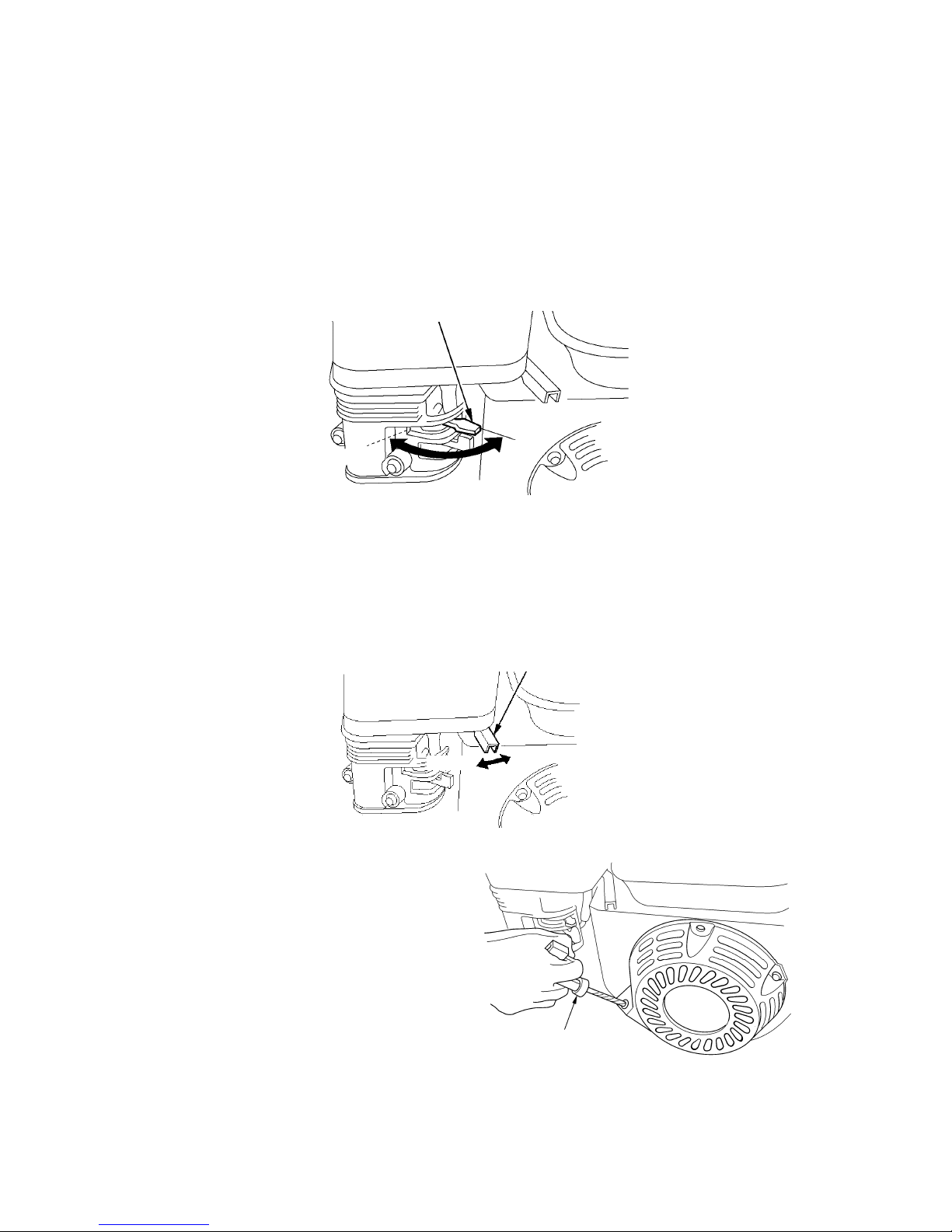
Fuel Valve Lever
The fuel valve opens and closes the passage between the fuel tank and the
carburetor.
The fuel valve lever must be in the ON position for the engine to run.
When the engine is not in use, leave the fuel valve lever in the OFF position to
prevent carburetor flooding and to reduce the possibility of fuel leakage.
Ignition Switch
The ignition switch controls the ignition system.
The ignition switch must be in the ON position for the engine to run.
Turning the ignition switch to the OFF position stops the engine.
OFF
ON
IGNITION SWITCH
FUEL VALVE LEVER
ON
O
FF

7
Choke Lever
The choke lever opens and closes the choke valve in the carburetor. The
CLOSED position enriches the fuel mixture for starting a cold engine.
The OPEN position provides the correct fuel mixture for operation after starting,
and for restarting a warm engine.
Throttle Lever
The throttle lever controls engine speed.
Moving the throttle lever in the directions shown makes the engine run faster or
slower.
Pump output is controlled by adjusting the throttle lever. At maximum throttle
position, the pump will deliver the highest output volume. Moving the throttle
lever toward the idle position will decrease the output volume of the pump.
Recoil Starter Grip
Pulling the recoil starter grip operates
the recoil starter to crank the engine.
RECOIL STARTER GRIP
OPEN
CL
O
SE
CHOKE LEVER
SL
O
W
THROTTLE LEVER
FAST

8
4. CHECK BEFORE OPERATION
Be sure of what you are pumping. This pump is designed to pump only fresh
water that is not intended for human consumption.
For your safety, and to maximize the service life of your equipment, it is very
important to take a few moments before you operate the pump to check its
condition. Be sure to take care of any problem you find, or have your servicing
dealer correct it, before you operate the pump.
Improperly maintaining this pump, or failing to correct a
problem before operation, could cause a malfunction in
which you could be seriously injured.
Always perform a preoperation inspection before each operation, and
correct any problem.
Exhaust gas contains poisonous carbon monoxide. Avoid inhalation of exhaust
gas. Never run the engine in a closed garage or confined area.
To prevent fire hazards, keep the pump at least 3 feet (1 meter) away from
building walls and other equipment during operation. Do not place flammable
objects close to the engine.
Before beginning your preoperation checks, be sure the pump is on a level
surface and the ignition switch is in the OFF position.
Check the General Condition of the Pump
Look around and underneath the pump for signs of oil or gasoline leaks.
Remove any excessive dirt or debris, especially around the engine muffler, and
recoil starter.
Look for signs of damage.
Check that all nuts, bolts, screws, hose connectors and clamps are tightened.
Check the Suction and Discharge Hoses
Check the general condition of the hoses. Be sure the hoses are in serviceable
condition before connecting them to the pump. Remember that the suction hose
must be reinforced construction to prevent hose collapse.
Check that the sealing washer in the suction hose connector is in good condition
(see page 13).

9
Check that the hose connectors and clamps are securely installed (see pages 13
& 14).
Check that the strainer is in good condition and is installed on the suction hose
(see page 13).
CHECK ENGINE OIL LEVEL
Check the engine oil level with the engine stopped and in a level position.
1. Remove the oil filler cap/dipstick and wipe it clean.
2. Insert and remove the dipstick without screwing it into the filler neck. Check
the oil level shown on the dipstick.
3. If the oil level is low, fill to the edge of the oil filler hole with the recommended
oil (see page 21).
4. Screw in the oil filler cap/dipstick securely.
Running the engine with a low oil level can cause engine
damage.
Engine oil capacities:
SUWP25:0.35L
SUWP50,SUWP80:0.6L
SUWP100:1.1L
AIR FILTER INSPECTION
A dirty air filter will restrict air flow to the carburetor, reducing engine and pump
performance.
OIL FILLER CAP/DIPSTICK
OIL FILLER NECK
UPPER LIMIT
LOWER LIMIT
Este manual sirve para los siguientes modelos
1
Tabla de contenidos
Otros manuales de Bomba de agua de iPower
Manuales populares de Bomba de agua de otras marcas

Sykes AmeriPumps
Sykes AmeriPumps GP100M Guía de solución de problemas

DUROMAX
DUROMAX XP WX Series Manual de usuario

BRINKMANN PUMPS
BRINKMANN PUMPS SBF550 Manual de usuario

Franklin Electric
Franklin Electric IPS Manual de usuario

Xylem
Xylem e-1532 Series Manual de usuario

Milton Roy
Milton Roy PRIMEROYAL Manual de usuario