
Hot Max PL-25 Manual de usuario

WARNING: Do not assemble, install, or operate this equipment without reading ALL of this manual
and the safety precautions and warnings illustrated in this manual.
OPERATOR’S MANUAL
Model PL-25
Plasma Cutter
KDAR Company Tel: (314) 692-8555
1 Mulch Lane Fax: (314) 692-8578
St. Louis, MO 63044 Web Site: www.hotmaxtorches.com

OPERATOR’S MANUAL
Model PL-25
Plasma Cutter
TABLE OF CONTENTS
Safety Symbols & Precautions 1
Specifications 4
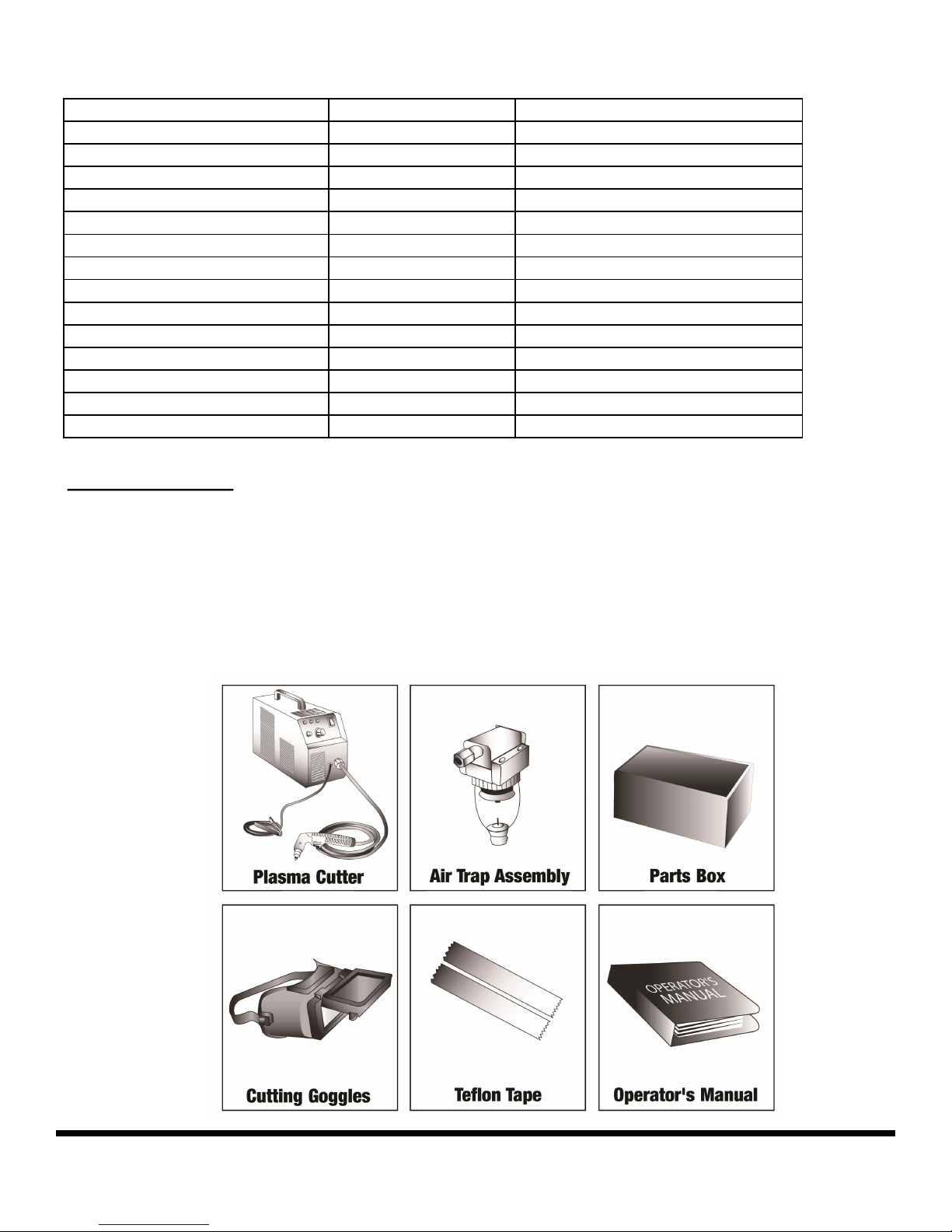
Package Contents 4
Installation and Setup 5
Operation—Safety 7
Operation—Controls 8
Operation—Design Features 9
Operation—Job Setup and Control Settings 10
Operation—Cutting 11
Maintenance 12
Maintenance—Replacing Consumables 13
Troubleshooting 14 - 15
KDAR Company

KDAR Company
SAFETY PRECAUTIONS AND WARNINGS
PLEASE READ BEFORE USING EQUIPMENT
Keep children away from this equipment
Protect your self and others from possible injury
Pacemaker wearers should consult with their doctor before operating
Read and follow all instructions in this manual before operating
All installation, operation, and maintenance procedures should be per-
formed only by qualified individuals
ELECTRIC SHOCK CAN KILL.
Plasma cutting uses more voltage than welding, as high as 200 to 400 volts DC when output is oper-
ating.
The input circuits are also live and hot when the power is on
Do not touch live electrical parts
Wear dry, hole free insulated work gloves and body protection when operating
Do not touch torch components if in contact with the work piece or ground
Always turn off power before cleaning, checking, or changing parts
Properly ground this piece of equipment per state and federal requirements
Inspect and replace any worn or damaged torch cables or leads
Keep all panels and covers securely in place
Keep away from the torch tip and pilot arc when trigger is pressed
Ground the metal or work piece to the ground cable (Earth Clamp)
Never dip the tip into water to cool or attempt to use cutter in or under water
This DC equipment holds a lot of power in the off position, before touching, make sure voltage is
near zero on input capacitors before touching any parts.
ARC RAYS CAN BURN SKIN AND EYES
Arc rays when cutting produce intense ultraviolet and infrared rays that can burn skin and eyes
Where face protection, either helmet or shield when operating with ANSI Z49.1 approved shade #5
recommended for all cutting currents less than 300 amperes. The lens should conform to ANSI
Z87.1 standards for testing.
Wear approved safety glasses with side shields under the face protection
Warn others not to stare at the arc as it can cause damage to the eyes. Provide barriers to protect
other workers in the area from the arc while operating
Wear flame resistant gloves, clothing, and shoes when operating
FUMES AND GASES CAN BE HAZARDOUS
Plasma cutting produces fumes and gases and breathing these gases is hazardous to your health
Keep your head out of the fumes and do not breath the fumes while cutting
Work only in a confined area if it has sufficient ventilation, or while wearing an air supplied respira-
tor. Fumes from cutting deplete the oxygen supply and can be harmful. Always be sure there is am-
ple breathing air
Read the MSDS sheets and the instructions from manufacturers for metals to be cut, coatings, and
cleaners
Do not use the Plasma cutter near hydrocarbon vapors coming from degreasing, cleaning, or spray-
ing operations. The heat and rays can react with solvent vapors to create the gas phosgene, a very
toxic gas and other irritating gases
Do not cut coated metals, such as galvanized, lead, or cadmium plated steel. Before cutting, all plat-
ing must be removed. The area must be well ventilated or an air supplied hood must be used. The
coatings and chemicals when burned cause highly irritating and toxic fumes.
Do not cut containers with toxic, flammable, or reactive elements stored in them. They must be
emptied and properly prepared before cut. They must be cleaned and prepared to cut by the AWS
F4.1 guidelines for cutting containers or tubes
WARNING
1

CUTTING SPARKS CAN CAUSE INJURY, FIRE, OR EXPLOSION
Remove all flammable materials from the plasma cutting and gouging area
Always have a charged fire extinguisher available in the cutting area
When not cutting make sure the cutting tip is not grounded, this causes a heat build up and possible
fire
Avoid cutting or gouging near hydraulic lines, fuel lines, electrical cords, air hoses, or welding guns
and cables
Sparks and hot metal fly out from the arc when cutting, wear approved safety glasses with side
shields under approved helmets, wear proper body and hand protection, and wear flame resistant ear
plugs to keep sparks from entering the ears
CYLINDERS CAN EXPLODE IF DAMAGED
Gas cylinders contain gas under very high pressure. If damaged they can result in that cylinder ex-
ploding. Gas cylinders are a major part of metalworking and must be treated with care.
Protect gas cylinders from excessive heat, mechanical shocks, slag, open flames, sparks, and arcs
Always keep cylinders in an upright position securely fastened to a fixed support
Valve protection caps should always be in place and hand tight except when the cylinder is in use
Keep all cylinders away from any cutting or electrical circuits
Never allow the arc from a plasma cutter to contact a cylinder
Never cut any type of pressurized cylinder, an explosion could result
Always turn your face away from the valve when opening the cylinder
Read and follow all instructions on compressed gas cylinders, associated equipment, and CGA pub-
lication P-1 listed in the Safety Standards before using
PLASMA ARC CAN INJURE
The heat from the plasma arc is very intense and forceful and can burn through protective clothing
and pierce skin causing serious burns
The pilot arc can cause severe burns, keep body away from the cutting tip when the trigger is de-
pressed
Always point the cutting tip away from your body when trigger is pressed, the pilot arc comes on
immediately
Do not hold or grip the material being cut close to the cutting tip
Always wear protective clothing when operating the cutter, cover all exposed body areas
Turn off power source and unplug unit when dis-assembling torch handle or replacing components
of gun
ELECTRIC AND MAGNETIC FIELDS MAY BE DANGEROUS
Electric current used in Plasma cutting and welding create Electric and Magnetic Fields (EMF)
Magnetic fields can affect pacemakers and wearers should avoid proximity to EMF. Wearers need to
contact their doctors before operating this type of equipment
Exposure to EMF during operation of this equipment may have other health effects which are not
yet known
Route the work and torch cables together and not around your body
Do not place your body between the torch cable and the work cable. They both need to be on the
same side of your body when operating
Do not work next to the cutting or welding machine
ELECTRICALLY POWERED EQUIPMENT
Disconnect power source or disconnect the switch at the fuse box before working on any equipment
Only install equipment using the US National Electrical Code, all local codes, and the manufactur-
er’s recommendations
Ground the equipment in accordance with the US National Electrical Code
KDAR Company 2

NOISE CAN DAMAGE HEARING
Prolonged noise exposure from cutting and welding equipment can cause damage if levels of noise
exceed the OSHA standards
Wear approved hearing protectors
Warn other workers nearby of the high noise level and hazard
CALIFORNIA PROPOSITION 65 WARNINGS
Welding or cutting equipment produces fumes or gases which contain chemicals known to the State of California to cause
birth defects, and in some cases, cancer. (California Health and Safety Code Section 25249.5 et seq.)
PRINCIPAL SAFETY STANDARDS
AMERICAN WELDING SOCIETY
AWS C5.2, Recommended Practices for Plasma Arc Cutting
AWS F4.1, Recommended Safe Practices for the Preparation for Welding and Cutting
OSHA STANDARDS
OSHA 29 CFR 1910, Safety and Health Standards
NATIONAL FIRE PROTECTION ASSOCIATION
NFPA Standard 70, National Electric Code
NFPA Standard 51B, Cutting and Welding Processes
AMERICAN NATIONAL STANDARDS INSTITUTE
ANSI Standard Z87.1, Safe practices for Occupation and Educational Eye and Face Protection
ANSI Standard Z49.1, Safety in Welding and Cutting
KDAR Company
HOT PARTS CAN CAUSE SERIOUS BURNS
Do not touch hat parts without wearing protection.
Allow the torch to cool sufficiently before working with parts that could potentially be
hot.
3
Specifications
Description Unit of Measure Value
Power Source Volts Single Phase AC115 (50~60HZ)
Open Circuit Voltage Volts 320
Rated Welding Current Amps 12~25
Rated Duty Cycle %30@15 Amps—50 @20 Amps
Power Factor COS Φ ≥ 0.8
Insulation Level F
Safety Class IP21S
Cool Mode Fan-cooled
Dimensions Inches 15.75 x 6.69 x 9.45
Net Weight #48
Max Compressed Air Pressure psi 145
Min Compressed Air Pressure psi 70
Flow of Compressed Air CFM 3.88
Cutting Thickness Inches 0.02~.60
Package Contents
Plasma Cutter with gun, ground clamp and power cord pre-assembled.
Air trap—pre-assembled
Parts Box containing 4 cutting nozzles, 1 long electrode and 1 quick coupler
20 Amp plug
1 pair of cutting goggles
Teflon tape or pipe dope
1 Operator’s Manual
KDAR Company 4

Installation/Setup
Warning
Safety Considerations
Electric Shock Can Kill
Only qualified personnel should attempt to install this equipment.
Turn off the input power at the fuse box or disconnect switch and discharge capacitors
before working inside the equipment.
Take care not to touch electrically hot parts
Make sure the unit is switched off before plugging it into a the power outlet.
Selecting A Location
The PL-25 should be placed where clean cool air can easily flow in and out of the unit’s side vents. Dirt and
dust can be drawn into the unit resulting in excessive operating temperatures and shutdowns, therefore, dirt
and dust around the unit should be kept to a minimum.
The PL-25 requires a supply of clean, dry air. Oil in the air will cause a problem with the PL-25 and must be
avoided. The air supply pressure must be between 65 and 145 psi. the Flow rate is about 3.9 cfm.
The PL-25 should be placed on a stable, level surface suitable to hold the unit’s weight.
Electrical Connections
The PL-25 is rated for 115VAC only and is shipped for operation on 115VAC 15 amp circuits. Use on 15 amp
circuits may limit cutting output or trip a fuse or breaker. To reach maximum output replace the 15 amp plug
on the power cord with a 20 amp plug (NEMA style 5-20P) and connect to a 20 amp circuit.
Warning Failure to properly wire the 20 amp plug could cause personal injury or damage
to the PL 25 Plasma Cutter.
This installation should be completed or checked by a qualified electrician only.
Gas/Air Supply Connections
1. Gas/air inlet fitting
2. Air Trap—Supplied
3. Quick connect coupler—Supplied
4. Teflon Tape—Supplied
Wrap inlet fitting (1) with Teflon tape and tread air trap to
inlet fitting, making sure arrow on top of inlet fitting is
pointing toward the PL-25. Wrap inlet fitting to air trap
with Teflon tape and tread quick connect coupler to air
trap. Connect the quick connect from the air supply to
quick connect coupler.
Adjust gas/air pressure per to instructions on page 10.
KDAR Company 5

Note: A pressure regulator must be used with nitrogen gas from a cylinder.
The pressure from the nitrogen gas cylinder to the PL-25 should never exceed 150 psi.
Install a hose between the regulator and the PL-25 inlet.
Installation/Setup
Damaged Cylinders Can Explode.
Warning
Keep cylinder upright and secured to a stable support.
Keep cylinder clear of areas and items that could damage the cylinder.
Be careful not to allow the cutting torch to touch the cylinder.
Always keep the cylinder clear of electrical parts.
Maximum pressure 150 psi.
KDAR Company 6

Operation
KDAR Company
Safety Considerations
Warning
Electric Shock Can Kill
Do not touch live electrical parts of the electrode with skin or wet clothing.
Insulate yourself from work and ground.
Always wear insulated gloves and keep them dry.
Plasma Arc Can Burn or Injure
Keep hands and body away from the nozzle and plasma arc.
Operate the pilot arc with extreme care; it can burn the operator or others and burne
through safety clothing.
Fumes & Gases Can Be Hazardous
Plasma cutter should only be used in a well ventilated area or with an exhaust
system.
Keep your head away from the fumes.
Arc Rays Can Burn Skin and Eyes
Always were eye, ear and body protection.
Cutting Sparks Can Cause Injury, Fire , or Explosion
Do not use near flammable material.
Do not cut or gouge on containers that have held combustibles.
7

Operation
KDAR Company
Controls—Front
1. Power Switch
2. Power on indicator light—green light will illumi-
nate whenever power is on.
3. Gas Pressure—will illuminate if air/gas pressure
falls below minimum requirements.
4. Thermal—will illuminate if the unit has exceeded
maximum safe operating temperature.
Note: Illumination of either the Gas Pressure or
Thermal light will coincide with the unit shut-
ting down. Do not turn off power when thermal
light is on, fan is needed to cool the unit.
5. Purge—press to test air flow
6. Output Control—Used to set cutting output.
7. Ground Clamp Wire
8. Cutting Nozzle Cable
Controls—Back
1. Air Pressure Gauge
2. Air inlet
3. Air Pressure Control Knob—pull up on knob turn
clockwise to increase pressure and counter clock-
wise to decrease pressure.
4. Power Cord
5. Grounding Terminal
6. Specifications Label
8
Tabla de contenidos
Otros manuales de Sistema de soldadura de Hot Max


Manuales populares de Sistema de soldadura de otras marcas


TAFA
TAFA 30*8B35 Manual de usuario

Lincoln Electric
Lincoln Electric INVERTEC V350-PRO CE Manual de usuario

ESAB
ESAB Buddy Arc 145 Manual de usuario

CIGWELD
CIGWELD 636804 Guía rápida

Red-D-Arc
Red-D-Arc DC-400 Manual de usuario

Hobart Welding Products
Hobart Welding Products Spool Gun DP 3035-10 Manual de usuario


