
Honeywell EVCS-CMPT9 Guía

EVCS-CMPT9 Compact Master
&
EVCS-XC10 Slave Exchange
Installation, Commissioning and Maintenance Manual
www.acornfiresecurity.com
www.acornfiresecurity.com

1
Introduction
An EVCS is a fixed, secure, bi-directional, full duplex voice communication system to assist fire fighters in an emergency in high
rise buildings or large sites where radio communication may not work, and covers the operation of fire telephones, disabled refuge
systems and the Disabled Toilet Alarm.
The Emergency Voice Communications System (EVCS) is designed to fully comply with BS5839-Part 9:2011
(abb. Pt9) for use as a fire telephone system, disabled refuge call system or as a combined system when both fire telephones and
disabled refuge points are required.
Suitability
Fire telephone systems are recommended for all public buildings and multi story buildings over four floors by BS9999.
Disabled refuge systems are required by Building Regulations Approved Document B for all non-domestic dwellings. Building
Regulations Approved Document B also requires all buildings where the public or disabled staff gain access to any floor other than
the ground floor using lifts or stairs are required to exit.
Product Overview
A Compact 9 unit comprises of two functional blocks; the master handset and outstations (type A, type B, duo, jack
points or disabled toilet alarm), with the quantities of these basic units being adjusted to suit the application, a maximum of 19
outstations can be used for this system. Other sized EVCS systems are available.
The Compact unit (EVCS) has been designed on a star topology. In most cases this will reduce the cable requirements
compared to all ring based systems. The topology consists of spurs, with each spur consisting of 1 off 2 core 1mm CSA cables
(see Cable Guidance for Network and Outstations section for cable type). Each spur can be up to 500m.
www.acornfiresecurity.com
www.acornfiresecurity.com

2
Important Safety Information
This equipment must only be installed and maintained by suitably skilled and competent person.
This equipment is defined as Class 1 in EN60065 (Low Voltage Directive) and must be earthed.
Caution
INDOOR USE ONLY
WARNING SHOCK HAZARD-
ISOLATE BEFORE OPENING
WARNING
TO REDUCE THE RISK OF FIRE OR
ELECTRIC SHOCK, DO NOT EXPOSE THIS
UNIT TO RAIN OR MOISTURE
W
ARNING
THIS UNIT MUST BE EARTHED
W
ARNING
NO USER SERVICABLE PARTS
Each Compact unit requires a 3A spur, returning to a breaker clearly marked EVCS DO NOT TURN OFF. If the units are
distributed around a site it is essential all units are on the same mains phase as they are classified TEN 230V, powering from
different phases can mean a 440V potential can be present in a unit during a major fault incident.
Anti-static handling guidelines
Make sure that electro-static handling precautions are taken immediately before handling PCBs and other static sensitive
components.
Before handling any static-sensitive items, operators should get rid of any electrostatic charge by touching a sound safety earth,
such as a radiator. Always handle PCBs by their sides and avoid touching any components. PCBs should be stored in a clean, dry
place that is free from vibration, dust and excessive heat.
Storing the PCBs in a suitable cardboard box will also guard them against mechanical damage.
www.acornfiresecurity.com
www.acornfiresecurity.com

3
Unpacking the EVCS-CMPT9 Compact Master Unit
Remove the Compact unit from its packing, and check the contents against the following list:
1. EVCS-CMPT9 Compact Master unit.
2. Installation & maintenance manual (this document).
3. User guide & logbook.
4. Accessory pack with the following contents:-
a. Spare mains fuse.
b. 2.5mm AF ALN key.
Using the ALN key supplied, open the right hand front cover.
Verify the following items are present:
1. 9 off outstation line connectors
2. 1 off 2 way fault connector
3. 1 off 2 way in use connector
4. 1 off 2 way access connector
5. 1 off 4 way network connector
If there are any Items missing please contact Honeywell, quoting the unit serial number, and the
name on the packing list enclosed so we can rectify the situation.
www.acornfiresecurity.com
www.acornfiresecurity.com

4
Unpacking the EVCS-XC10 Compact Slave Exchange
Remove the Compact unit from its packing, and check the contents against the following list:
1. EVCS-XC10 Compact slave unit.
2. Installation & maintenance manual (this document).
3. User guide & logbook.
4. Accessory pack with the following contents:-
a. Spare mains fuse.
b. 2.5mm AF ALN key.
Using the ALN key supplied, open the front cover.
Verify the following items are present:
1. 10 off outstation line connectors
2. 1 off 4 way network connector
If there are any items missing please contact Honeywell, quoting the unit serial number, and the
name on the packing list enclosed so we can rectify the situation.
www.acornfiresecurity.com
www.acornfiresecurity.com
5
Preparation
Remove the front door plate containing the circuit board by unscrewing the door hinge. This has a connection to the base PCB,
which needs to be removed. Exercise static precautions to prevent damage to the electronics. Store the front panel assembly
safely until the master handset is mounted and cables have been attached.
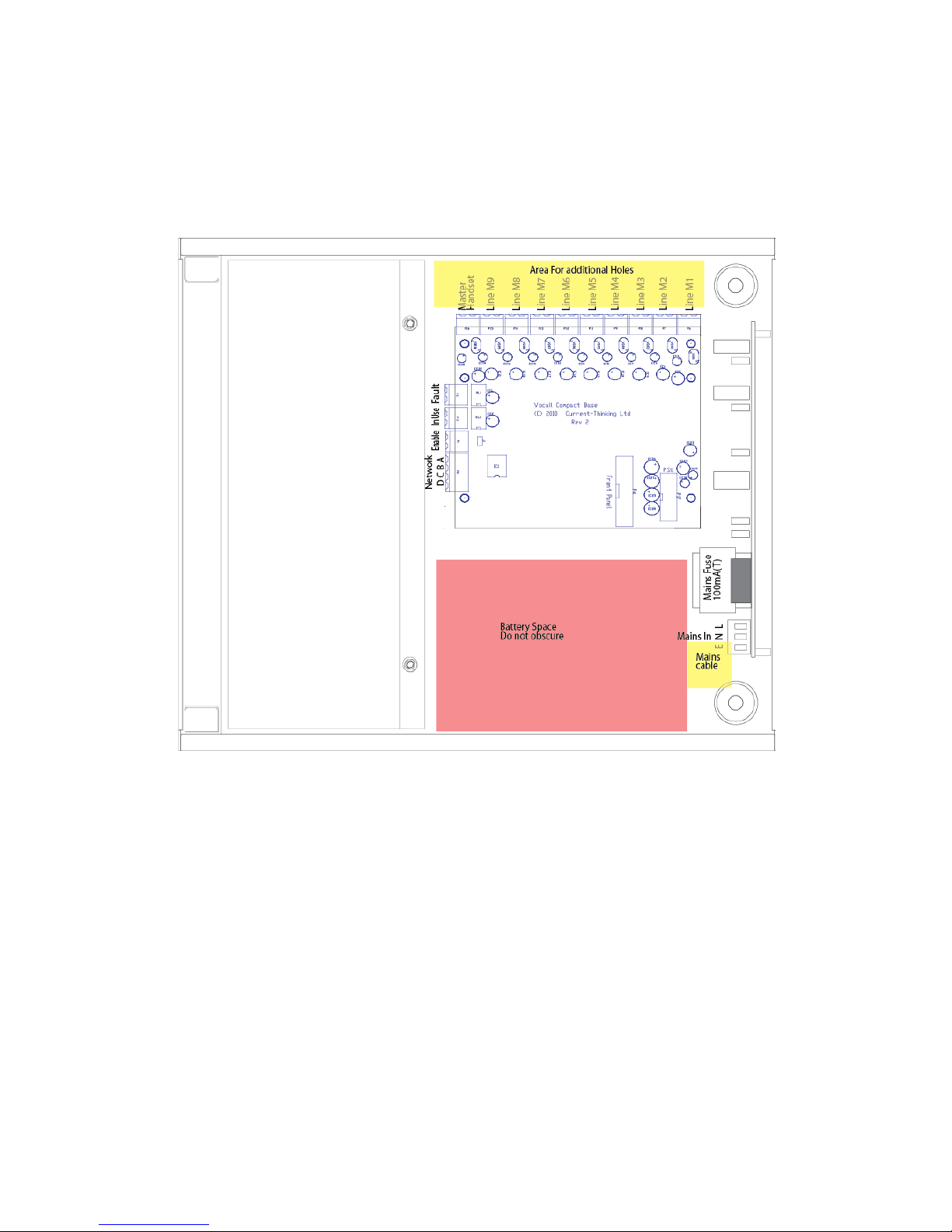
Before mounting the unit on the wall it is advisable to remove the cable knockouts. Decide how the wiring will be brought into the
panel and remove the required knockouts for cable entry. If a knockout is removed, fill the hole with a good quality cable gland.
On the bottom face a single knockout is for the incoming mains. Mains SHOULD NOT enter the box by any other hole. If additional
holes are required, then the can be drilled as shown below, taking care not to obscure the battery or PCB locations.
Unused knockouts must be left unopened to comply with the LVD. Accidentally knocked out holes should be blanked off. This work
must be carried out prior to the re-installation of circuit boards.
www.acornfiresecurity.com
www.acornfiresecurity.com

6
Mounting the Compact unit
The Compact unit weighs 4Kgs with batteries, so care should be taken to securely mount the unit on stud walling.
Connecting the Compact unit
To comply with EMC (Electro Magnetic Compatibility) regulations and to reduce the risk of electrical interference in the system
wiring, we recommend the use of fire-resistant screened cables throughout the installation.
All wiring should come into the enclosure via the knockouts provided, and be fixed tidily to the relevant terminals.
Note that correct cable glanding is essential and due regard should be paid to any system specifications which demand a certain
cable type (providing it meets the appropriate national wiring regulations).
Planning the Wiring
All system wiring should be installed to meet the appropriate parts of BS5839-9 (2011) and BS 7671 (Wiring Regulations). Other
national standards of installation should be adhered to where applicable.
Do not test wiring with an insulation tester (Megger) with any equipment or outstations connected, as the 500 Volt test voltage will
destroy these devices totally.
You must observe local wiring regulations. Do not run SELV and LV cables in the same enclosure without adequate insulation
between them.
Mains Connection
Each compact requires a 3A spur, returning to a breaker clearly marked “EVCS DO NOT TURN OFF”. If the units are distributed
around a site it is essential all units are on the same mains phase, as they are classified TEN 230V, powering from different phases
can mean a 440V potential can be present in a unit during a major fault incident.
>3mm
3A
Main
Distribution
Board
>0.75mm
2
<2.5mm
2
UNITY
DA
Compact
9
www.acornfiresecurity.com
www.acornfiresecurity.com

7
Batteries
The compact requires one number 12V 5AH sealed lead acid batteries to provide backup power in the event of mains failure as
defined in BS5839pt9 for 24 hours standby and 3 hours operation when powered by normal mains supply.
For 72hour standby and 1 hour operation one number 12V 17AH battery is required, these will need to be fitted in an external
battery enclosure. The monitored charger in the Compact unit is capable of charging and monitoring these batteries.
Safety Information:
Sealed Lead acid batteries contain sulphuric acid which can cause burns if exposed to the skin. The low
internal resistance of these batteries means large currents will flow if they are accidentally short
circuited, causing burns and a risk of fire- exercise caution when handling batteries.
Power up Procedure:
Always apply mains power before connecting batteries. Do not commission the Compact unit
on batteries, as the high inrush current required by the power supply may rupture the battery fuse.
Always connect the Positive (Red +) terminal first, then the Negative (Black -)
To down power reverse the power up sequence.
www.acornfiresecurity.com
www.acornfiresecurity.com

8
Outstation Wiring
The compact unit requires programming to determine the outstation configuration;
Four types of handset are allowed on the system, type A (fixed phone) type B (hands-free refuge points), disabled toilet alarms and
jack plates.
For jack points a 10K EOL resistor is required at the OUT of the last plate on the line.
Cable Guidance for Compact Unit and Outstations
Following the publication of BS5839pt9:2011, the guidance on cables for the Compact unit has changed, following a
relaxation in the requirements of the standard.
Type A Outstations
Any system with fire fighting telephones (Type A outstations) must have all wiring to these outstations and any necessary network
cables interconnecting parts of the system in Enhanced fire rated cables.
Type B Outstations
In buildings under 30 metres in height, or any building with sprinklers fitted, the wiring of Type B (hands-free) disabled refuge points
may be in standard fire rated cable as long as the planned evacuation will be completed within 30 minutes. If the building is over
30metres in height without sprinklers, or where the evacuation will take place over multiple stages exceeding 30 minutes, enhanced
fire rated cables must be used.
Disabled toilet call points
The revised BS5839pt9:2011 now recognises the addition of disabled toilet call systems to the Compact unit, however
gives no guidance on their use, as this is in Building Regulations Approved Document M.
There is no requirement for these systems to be monitored or battery backed. However with the EVCS-TA toilet extension we
have included these features as standard. The only cable requirement may come from the building design statement, and typically
this will require low smoke and fume cables (LSF), although they can also be wired in standard fire rated cable for ease of
identification.
Combined Systems
When a system consists of a mix of Type A and Type B outstations, the wiring must be enhanced fire rated for any shared resource
such as network cables, but individual spurs to type B outstations can be wired in standard fire rated cable as long as the distance
covered by that cable does not exceed 30 metres vertically in non-sprinklered buildings, or the evacuation plan for this segment of
the building will not exceed 30 minutes.
General Guidance
In complex buildings or where systems are being quoted without access to the fire evacuation plan we recommend all wiring to be
enhanced, or suitable caveats and detailed assumptions are placed on the design certificate required by BS5839pt9:2011.
www.acornfiresecurity.com
www.acornfiresecurity.com

9
Handsets (Type A):
Hands Free Refuge Point (Type B)
Disabled Toilet Alarm
Master to Slave Connection
www.acornfiresecurity.com
www.acornfiresecurity.com
Este manual sirve para los siguientes modelos
1
Tabla de contenidos
Otros manuales de Teléfono de emergencia de Honeywell


Manuales populares de Teléfono de emergencia de otras marcas


Paso
Paso PA8506-V Manual de usuario

JNY Safetycare
JNY Safetycare FDC Manual de usuario

Rath
Rath 2100-TL9 Manual de usuario

Eldat
Eldat Easywave Fon Alarm Manual de usuario

Merak
Merak MMk-656 Manual de usuario

Assistive Technology Services
Assistive Technology Services TOUCH N TALK FD Instrucciones de montaje