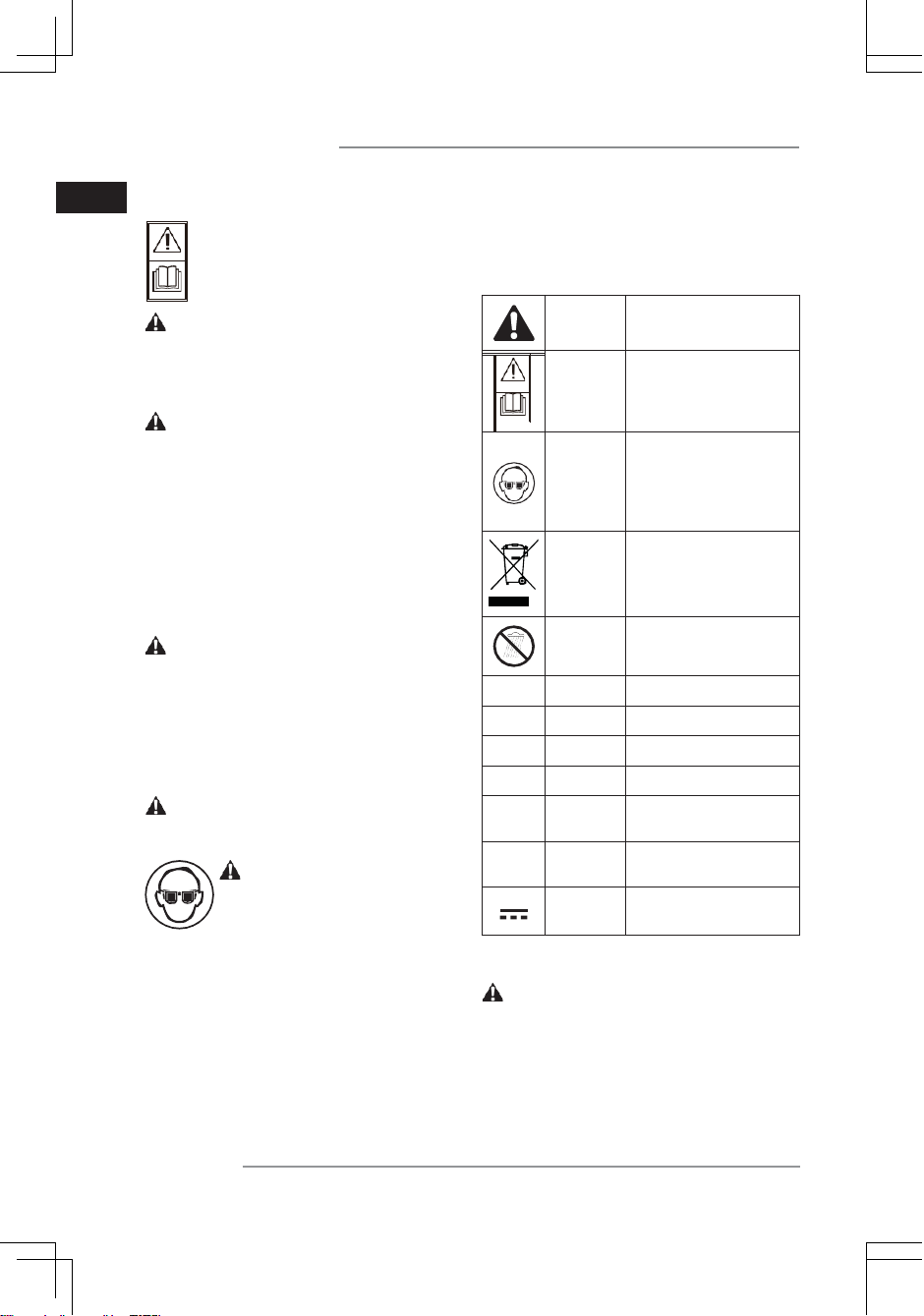
Save all warnings and instructions for future
reference.
Theterm“power tool”inthewarningsreferstoyour
mains-operated (corded) power tool orbattery-operated
(cordless) powertool.
WORK AREA SAFETY
◾
Keepworkareacleanandwelllit.
Clutteredordark
areas inviteaccidents.
◾
Do not operate power tools in explosive
atmospheres
,
such as in the presence of
flammable liquids, petrol or dust.
Power tools create
sparkswhichmay ignitethedustorfumes.
◾
Keep children and bystanders away while
operating a power tool.
Distractions can cause you
to lose control.
ELECTRICAL SAFETY
◾
Power tool plugs must match the outlet. Never
modify the plug in anyway. Do not use any adaptor
plugs with earthed (grounded) power tools.
Unmodified plugs and matching outlets will reducerisk
of electricshock.
◾
Avoid body contact with earthed or grounded
surfaces,such as pipes, radiators,ranges and
refrigerators.
There is an increased risk of electric
shock if your body is earthed or grounded.
◾
Do not expose power tools to rain or wet
conditions.
Water entering a power tool will increase
the risk of electric shock.
◾
Donotabusethecord.Neverusethecordfor
carrying,pulling orunplugging the power tool.
Keep cord away from heat, oil, sharp edges or
moving parts.
Damaged or entangled cords increase
the risk of electric shock.
◾
When operating a power tool outdoors, use an
extension cord suitable for outdoor use.
Use of
acordsuitableforoutdoorusereducestheriskof
electric shock.
◾
Ifoperatingapowertoolinadamplocationis
unavoidable,use aGround-fault circuit interrupter
protectedsupply.
Useof GFCIreducestheriskof
electric shock.
PERSONAL SAFETY
◾
Stayalert,watchwhatyouaredoinganduse
common sense when operating a power tool. Do
notuseapowertoolwhileyouaretiredor under
theinfluenceofdrugs,alcohol,ormedication.
A
moment of inattention while operating power tools may
result in serious personal injury.
◾
Use personal protective equipment. Always wear
eye protection.
Protective equipment such as dust
mask, non-skid safety shoes, hard hat, or hearing
protection used for appropriate conditions will reduce
personal injuries.
◾
Prevent unintentional starting. Ensure the switch
is in the off-position before connecting to power
source and/or battery pack, picking up or carrying
thetool.
Carryingpowertoolswithyourfingeronthe
switchorenergizingpowertoolsthathavetheswitch
on invitesaccidents.
◾
Removeanyadjustingkeyorwrenchbefore
turningthepowertoolon.
Awrenchorakeyleft
attachedtoarotatingpartofthepowertoolmayresult
in personalinjury.
◾
Do not overreach.Keep proper footing and balance
atalltimes.
Thisenablesbettercontrolofthepower
tool in unexpected situations.
◾
Dress properly. Do not wear loose clothing or
jewelry. Keep your hair,clothing and gloves away
from moving parts.
Loose clothes, jewelry or long hair
can be caught in moving parts.
◾
If devices are provided for the connection of dust
extraction and collection facilities, ensure these
are connected and properly used.
Use of dust
devices can reduce dust-related hazards.
POWER TOOL USE AND CARE
◾
Do not force the power tool. Use the correct power
toolforyourapplication.
Thecorrectpowertoolwill
dothejobbetterandsaferattherateforwhichitwas
designed.
◾
Donotusethepowertooliftheswitchdoesnotturnit
onandoff.
Anypowertoolthatcannotbecontrolledwith
the switch is dangerous and must be repaired.
◾
Disconnect the plug from the power source and/or
the batterypack from the power tool before making
anyadjustments,changingaccessories,orstoring
power tools.
Suchpreventivesafetymeasuresreduce
theriskofstartingthepowertoolaccidentally.
◾
Store idle power tools out of the reach of children
anddonotallowpersonsunfamiliarwiththe
power tool or these instructions to operate the
power tool.
Power tools are dangerous in the hands of
untrained users.
◾
Maintain power tools. Check for misalignment or
bindingofmovingparts,breakageofpartsand
any other condition that may affect the power
tool’s operation. If damaged, have the power tool
repaired before use.
Many accidents are caused by
poorly maintained power tools.