Hach SP-510 Manual rápido

DOC023.98.80422
SP-510
06/2018, Edition 10
Basic User Manual
Basis-Benutzerhandbuch
Manuel d'utilisation de base
Manual básico del usuario
Manuale di base per l'utente
Grundlæggende brugerhåndbog
Allmän användarhandbok
Osnovni korisnički priručnik
Temel Kullanım Kılavuzu

English..............................................................................................................................3
Deutsch.......................................................................................................................... 23
Français......................................................................................................................... 44
Español.......................................................................................................................... 65
Italiano............................................................................................................................ 86
Dansk............................................................................................................................107
Svenska....................................................................................................................... 127
Hrvatski........................................................................................................................ 147
Türkçe...........................................................................................................................167
2

Table of contents
Specifications on page 3 Calibration on page 17
General information on page 4 Operation on page 18
Installation on page 8 Maintenance on page 18
User interface and navigation on page 16 Troubleshooting on page 20
Startup on page 17
Expanded manual version
For additional information, refer to the expanded version of this manual, which is available on the
manufacturer's website.
Specifications
Specifications are subject to change without notice.
General specifications
Specification Details
Dimensions (W x D x H) 42 x 31.5 x 18 cm (16.5 x 12.5 x 7 in.)
Enclosure rating IP62
Weight 11.3 kg (25 lbs)
Installation environment Indoor
Mount Wall
Pollution degree/installation category 2/II
Protection class I
Altitude Maximum 2000 m (6562 ft)
Light source Class 1 LED (light emitting diode) with peak wavelength of 610 nm.
Estimated 50,000 hours minimum life; hard water and soft water
indicator.
Detector Silicon photo detector
Optical path length 8.89 mm (0.35 in.)
Time delay One reading above the trip point is necessary to trigger a soft-to-hard
water alarm transition. One reading below the trip point is necessary to
trigger a hard-to-soft water alarm transition.
Trip point 0.3, 1, 2, 5, 10, 20, 50 and 100 mg/L. Refer to Trip point specifications
on page 4.
Reagents Buffer and indicator solution. 500 mL of each reagent every 2 months.
Reagent shelf life 1 year
Power requirements 115/230 VAC, 70 VA, 50/60 Hz, 1.25 A Fuse
Electrical connections Two 3-wire barrier terminal blocks. Wire range: 18–12 AWG
(0.75–1.0 mm2)
Hard water alarm relay SPDT relay, set to on when the hard water indicator is on. The alarm
can be disabled.
Contact rating 5 A resistive at 100–240 VAC
English 3

Specification Details
Operating temperature 5 to 40 °C (32 to 104 °F)
Storage temperature -40 to 60 °C (-40 to 140 °F)
Operating humidity Relative humidity: 5–95% at different temperatures, non-condensing
Sampling rate New sample: every 1.9 minutes ±5% at 60 Hz; 2.3 minutes ±5% at
50 Hz
Sample flow rate to sample conditioning 50 to 500 mL/minute flow rate necessary (250 mL/minute
recommended)
Inlet pressure to instrument 1 to 5 psig (0.07 to 0.34 bar), 1.5 psig (0.1 bar) is optimum, > 5 psig
(0.34 bar) can cause sample tubing failure
Inlet pressure to sample conditioning 1.5 psig to 75 psig (0.1 to 5.2 bar)
Inlet fitting At instrument, 6.35 mm (0.25 in.) OD polyethylene tubing with quick-
disconnect fitting
Drain fitting Hose barb for 12.7 mm (0.5 in.) ID flexible tubing
Sample temperature range 5 to 40 °C (41 to 104 °F)
Certifications CE, cETLus
Warranty 1 year (EU: 2 years)
Trip point specifications
Alarm trip point Minimum trip value Maximum trip value Temperature influence on trip point
0.3 mg/L 0.22 mg/L 0.38 mg/L –0.03 mg/L per °C
1 mg/L 0.75 mg/L 1.25 mg/L –0.03 mg/L per °C
2 mg/L 1.5 mg/L 2.5 mg/L –0.03 mg/L per °C
5 mg/L 3.75 mg/L 6.25 mg/L –0.06 mg/L per °C
10 mg/L 7.5 mg/L 12.5 mg/L –0.08 mg/L per °C
20 mg/L 15.0 mg/L 25.0 mg/L –0.09 mg/L per °C
50 mg/L 37.5 mg/L 62.5 mg/L –0.29 mg/L per °C
100 mg/L 75.0 mg/L 125.0 mg/L –0.60 mg/L per °C
General information
In no event will the manufacturer be liable for direct, indirect, special, incidental or consequential
damages resulting from any defect or omission in this manual. The manufacturer reserves the right to
make changes in this manual and the products it describes at any time, without notice or obligation.
Revised editions are found on the manufacturer’s website.
Safety information
N O T I C E
The manufacturer is not responsible for any damages due to misapplication or misuse of this product including,
without limitation, direct, incidental and consequential damages, and disclaims such damages to the full extent
permitted under applicable law. The user is solely responsible to identify critical application risks and install
appropriate mechanisms to protect processes during a possible equipment malfunction.
Please read this entire manual before unpacking, setting up or operating this equipment. Pay
attention to all danger and caution statements. Failure to do so could result in serious injury to the
operator or damage to the equipment.
4 English

Make sure that the protection provided by this equipment is not impaired. Do not use or install this
equipment in any manner other than that specified in this manual.
Use of hazard information
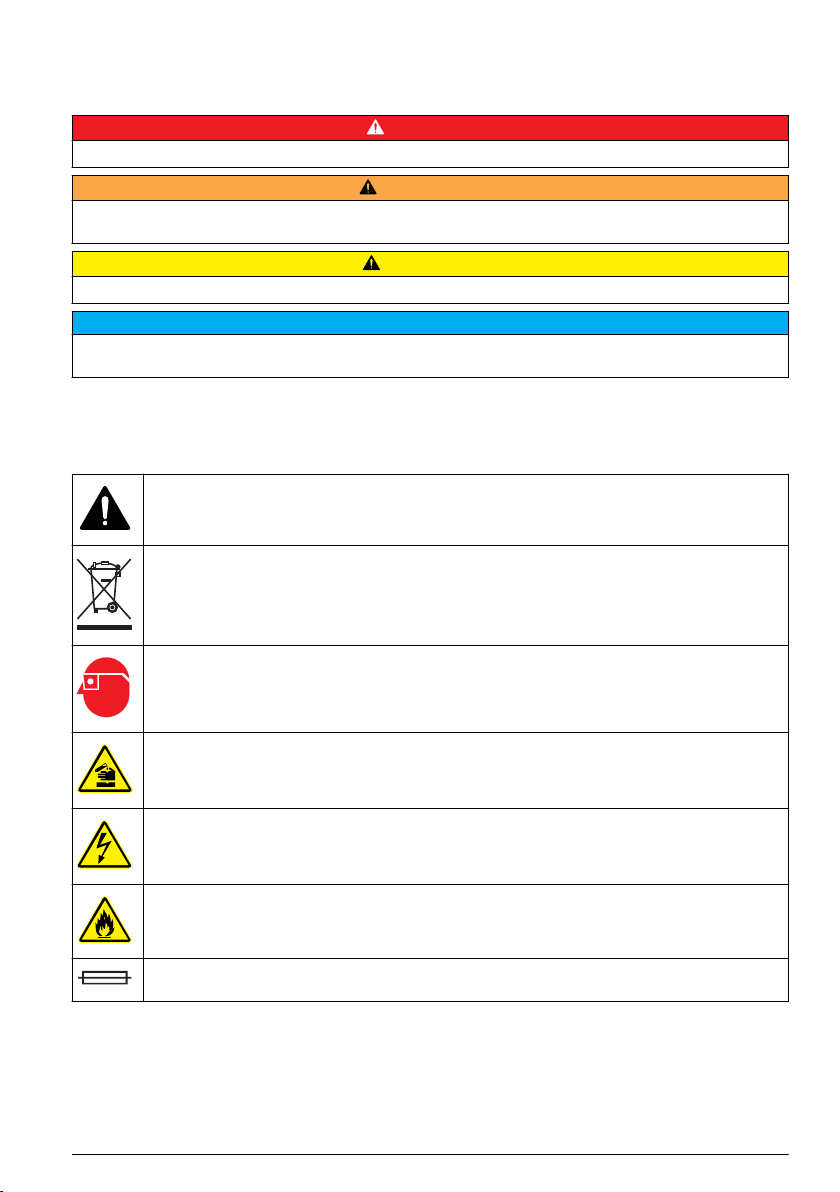
D A N G E R
Indicates a potentially or imminently hazardous situation which, if not avoided, will result in death or serious injury.
WARNING
Indicates a potentially or imminently hazardous situation which, if not avoided, could result in death or serious
injury.
CAUTION
Indicates a potentially hazardous situation that may result in minor or moderate injury.
N O T I C E
Indicates a situation which, if not avoided, may cause damage to the instrument. Information that requires special
emphasis.
Precautionary labels
Read all labels and tags attached to the instrument. Personal injury or damage to the instrument
could occur if not observed. A symbol, if noted on the instrument, will be included with a danger or
caution statement in the manual.
This is the safety alert symbol. Obey all safety messages that follow this symbol to avoid potential
injury. If on the instrument, refer to the instruction manual for operation or safety information.
Electrical equipment marked with this symbol may not be disposed of in European domestic or public
disposal systems. Return old or end-of-life equipment to the manufacturer for disposal at no charge to
the user.
This symbol indicates the need for protective eye wear.
This symbol identifies a risk of chemical harm and indicates that only individuals qualified and trained
to work with chemicals should handle chemicals or perform maintenance on chemical delivery
systems associated with the equipment.
This symbol indicates that a risk of electrical shock and/or electrocution exists.
This symbol indicates that a risk of fire is present.
This symbol, when noted on the product, identifies the location of a fuse or current limiting device.
Certification
Canadian Radio Interference-Causing Equipment Regulation, IECS-003, Class A:
Supporting test records reside with the manufacturer.
English 5

This Class A digital apparatus meets all requirements of the Canadian Interference-Causing
Equipment Regulations.
Cet appareil numérique de classe A répond à toutes les exigences de la réglementation canadienne
sur les équipements provoquant des interférences.
FCC Part 15, Class "A" Limits
Supporting test records reside with the manufacturer. The device complies with Part 15 of the FCC
Rules. Operation is subject to the following conditions:
1. The equipment may not cause harmful interference.
2. The equipment must accept any interference received, including interference that may cause
undesired operation.
Changes or modifications to this equipment not expressly approved by the party responsible for
compliance could void the user's authority to operate the equipment. This equipment has been tested
and found to comply with the limits for a Class A digital device, pursuant to Part 15 of the FCC rules.
These limits are designed to provide reasonable protection against harmful interference when the
equipment is operated in a commercial environment. This equipment generates, uses and can
radiate radio frequency energy and, if not installed and used in accordance with the instruction
manual, may cause harmful interference to radio communications. Operation of this equipment in a
residential area is likely to cause harmful interference, in which case the user will be required to
correct the interference at their expense. The following techniques can be used to reduce
interference problems:
1. Disconnect the equipment from its power source to verify that it is or is not the source of the
interference.
2. If the equipment is connected to the same outlet as the device experiencing interference, connect
the equipment to a different outlet.
3. Move the equipment away from the device receiving the interference.
4. Reposition the receiving antenna for the device receiving the interference.
5. Try combinations of the above.
Product overview
D A N G E R
Chemical or biological hazards. If this instrument is used to monitor a treatment process and/or
chemical feed system for which there are regulatory limits and monitoring requirements related to
public health, public safety, food or beverage manufacture or processing, it is the responsibility of the
user of this instrument to know and abide by any applicable regulation and to have sufficient and
appropriate mechanisms in place for compliance with applicable regulations in the event of malfunction
of the instrument.
The SP-510™ Hardness Monitor continuously measures water softener levels to find hardness
breakthroughs based on softener exhaustion. The monitor is used in commercial and industrial water
applications. The monitor has an automatic control system that starts regeneration sequences with
the alarm circuit.
Hardness is measured at different levels as CaCO3 with the applicable indicator and reagent
solutions. A relay closes when the instrument measures a hardness value that is more than the trip
point. Refer to Figure 1 for the product overview.
6 English

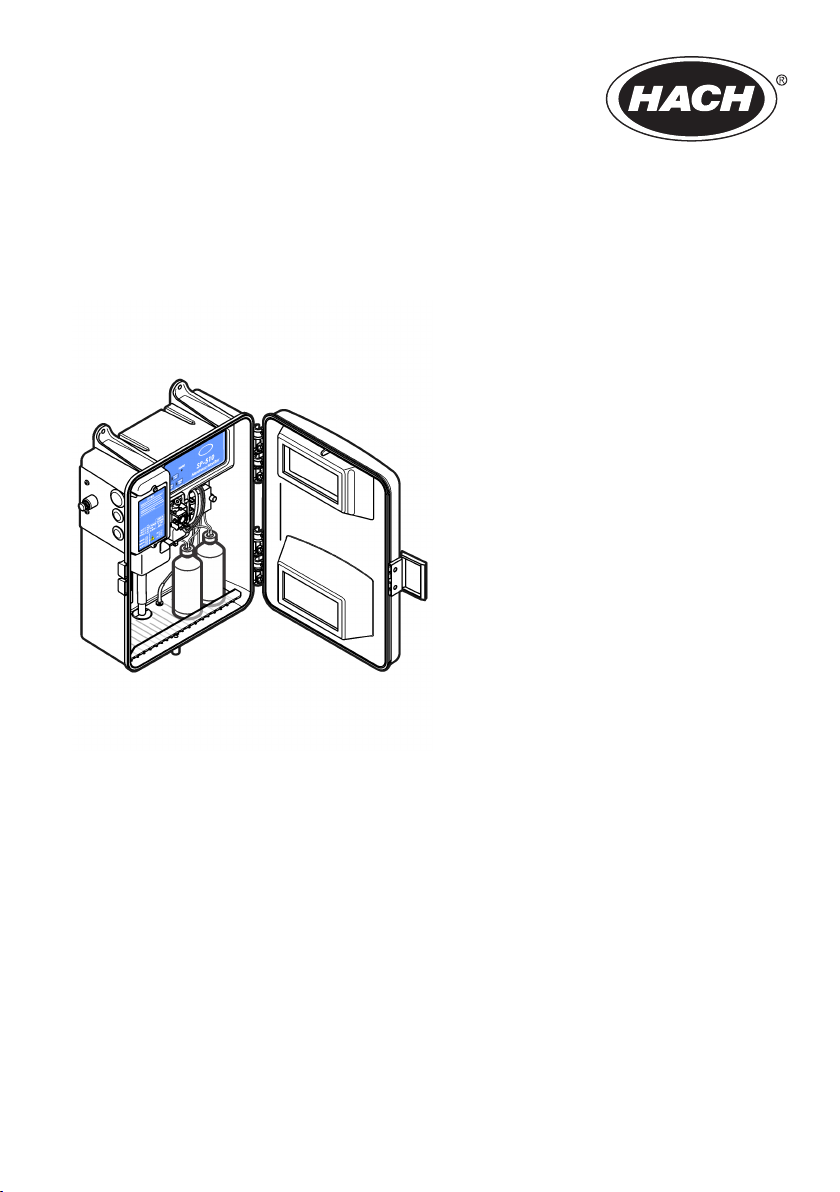
Figure 1 Product overview
1 Power switch 7 Keypad
2 Power access port 8 Pump/valve module
3 Relay and alarm contact access port 9 Indicator and reagent bottles
4 Air purge (optional) 10 Sample inlet
5 Access cover 11 Enclosure drain
6 Colorimeter 12 Sample drain
Product components
Make sure that all components have been received. Refer to Figure 2. If any items are missing or
damaged, contact the manufacturer or a sales representative immediately.
English 7

Figure 2 Product components
1 SP-510 Hardness Monitor 5 Indicator solution
2 Installation kit16 Magnesium sulfate solution
3 Maintenance kit27 TitraVer® (EDTA) hardness titrant
4 Buffer solution
Installation
D A N G E R
Electrocution hazard. Always remove power to the instrument before making electrical connections.
D A N G E R
Multiple hazards. Only qualified personnel must conduct the tasks described in this section of the
document.
Install the instrument
Install this instrument on an indoor wall, away from direct sunlight.
• For a complete purge of the sample line during each cycle, install the instrument as close to the
sample point as possible.
• Leave sufficient clearance at the bottom and sides for tubing and cable connections.
Refer to Figure 3 and Figure 4.
1Refer to the installation kit documentation for more information.
2Refer to the maintenance kit documentation for more information.
8 English

Figure 3 Dimensions for wall installation
Figure 4 Door clearance
Plumb the instrument
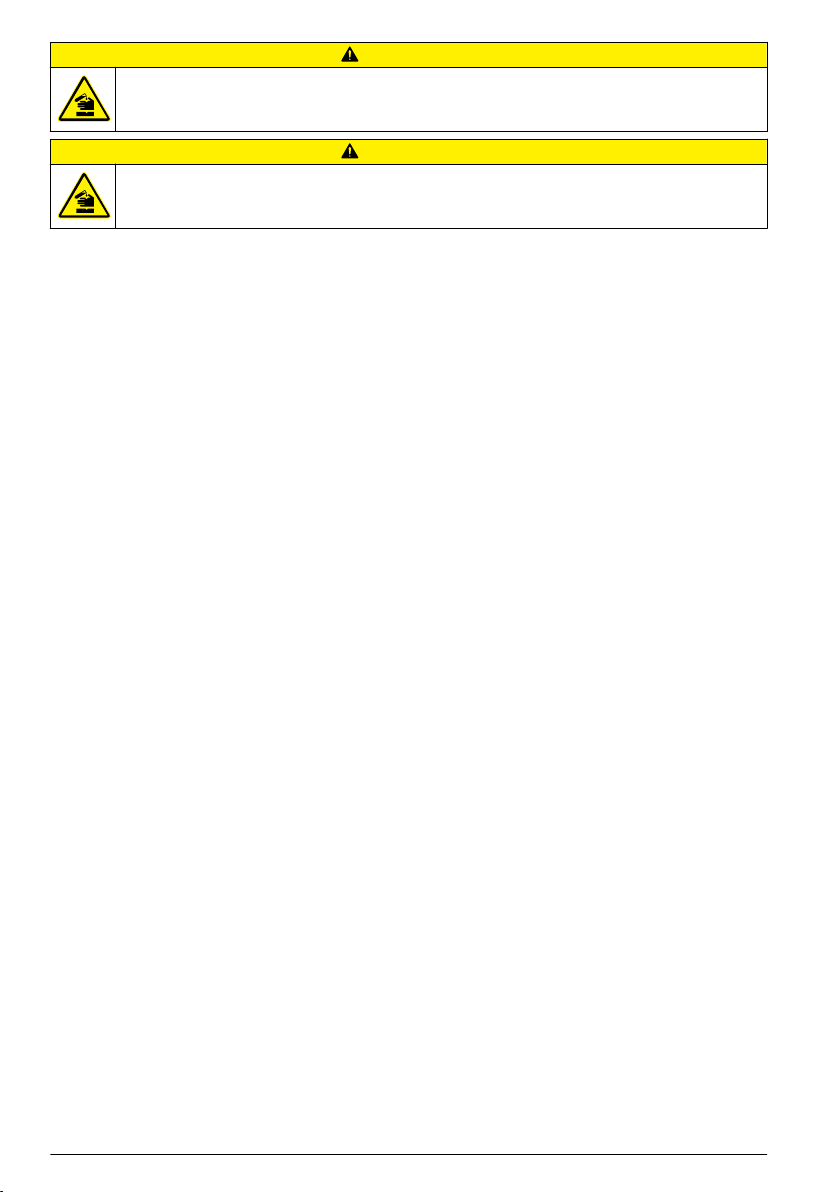
CAUTION
Fire hazard. This product is not designed for use with flammable liquids.
English 9

CAUTION
Chemical hazard. If there is a leak in the fluid system, hazardous substances may leak out of the lower
enclosure. Put the supplied reagent bottle tray or a bucket under the drain to catch any spills.
CAUTION
Chemical exposure hazard. Dispose of chemicals and wastes in accordance with local, regional and
national regulations.
Use quick-connect type connectors for ¼-inch OD tubes to install the sample inlet and drain
connections.
1. Install 3 feet of tubing in the ½-inch enclosure drain to keep dust out of the analyzer. Refer to
Figure 1 on page 7, item 11.
Note: Make sure that the enclosure drain is open. The drain must be open to remove sample water if leaks
occur.
2. Push the ¼-in OD poly tube on the sample line connector. The tube will "stop" two times as it is
pushed on the connector. For more information, refer to the installation kit documentation.
3. Make sure that the tubes are pushed completely on the connector. Incorrect installation can
cause the tube to come off of the connector when water pressure is applied.
Note: The sample drain connector will install on ½-inch ID flexible tubes (customer-supplied).
Connect the air purge (optional)
An air purge is necessary in an environment with high humidity or caustic vapors. Additional
information is available on the manufacturer's website.
Sample line guidelines
Select a good, representative sampling point for the best instrument performance. The sample must
be representative of the entire system.
To prevent erratic readings:
• Collect samples from locations that are sufficiently distant from points of chemical additions to the
process stream.
• Make sure that the samples are sufficiently mixed.
• Make sure that all chemical reactions are complete.
Connect the sample stream
Install the sample line into the center of a larger process pipe to minimize interference from air
bubbles or bottom sediment. Figure 5 shows examples of good and bad installation.
Keep the sample lines as short as possible to prevent the accumulation of bottom sediment. The
sediment can absorb some of the analyte from the sample and cause low readings. The sediment
can later release the analyte and cause high readings. This exchange with the sediment also causes
a delayed response when the analyte concentration in the sample increases or decreases.
10 English
Otros manuales para SP-510
3
Tabla de contenidos
Idiomas:
Otros manuales de Monitor de Hach