
Drummond MTL10 Manual de usuario

MTL10 & MTL20 TEST LAMPS
Instruction
Manual

ALWAYS READ THESE INSTRUCTIONS BEFORE PROCEEDING
Thank you for buying one of our products. For safety and full
understanding of its benets please read this manual before use.
Technical support is available from +44 (0)1923 441717 and
CONTENTS
1 Description 1
2 Safety Information 2
2.1 Meaning of Symbols and Markings 2
2.2 Precautions 3
2.3 Safety Advice 5
3 Introduction 6
3.1 Inspection 6
3.3 Accessories 6
4 Operation 7
4.1 Control Elements and Connections 7
4.2 Description of LED Indicators 8
4.3 Operating Duty Ratio 8
4.4 Proving Check 9
4.5 Testing for the Presence of Hazardous Live Voltage 10
4.6 Push Button Switches (MTL20 only) 10
4.7 Interference (Phantom) Voltage 11
5 Maintenance 12
5.1 Probe Replacement 12
5.2 Periodic Testing 12
5.3 Cleaning 12
5.4 Repair and Service 13
5.5 Storage Conditions 13
6 Warranty 14
Measurement Categories
Specications

1
1. Description
The MTL10 and MTL20 test lamps are two-pole voltage indicators /
detectors for universal applications. They are designed to be used
by skilled persons in accordance with safe methods of work, and
are constructed in accordance with the applicable safety standards
to provide safe and reliable indication.
The MTL10 and MTL20 have the following features:
•AC and DC Voltage tests up to 500V AC and 750V DC
•Bright LED indication
•Full voltage indication function without batteries
• PTC thermistor tted in probe to limit current in the event of
cable damage
•Contrasting colour of inner sheath to highlight cable damage
•Ergonomic and robust housing
•Probe tips comply with GS38
•Measurement Category CAT IV 600V
•Constructed in compliance with BS EN 61243-3:2010
•IP64 rated environmental protection for internal electronics
2
2. SAFETY INFORMATION
REMEMBER: SAFETY IS NO ACCIDENT
These instructions contain both information and warnings that are
necessary for the safe operation and maintenance of this product. It
is recommended that you read the instructions carefully and ensure
that the contents are fully understood. Failure to understand and
to comply with the warnings and instructions can result in serious
injury, damage or even death.
Particular attention should be paid to the Warnings, Precautions
and Technical Specications.
Please keep these instructions for future reference.
Updated instructions and product information are available at:
www.martindale-electric.co.uk
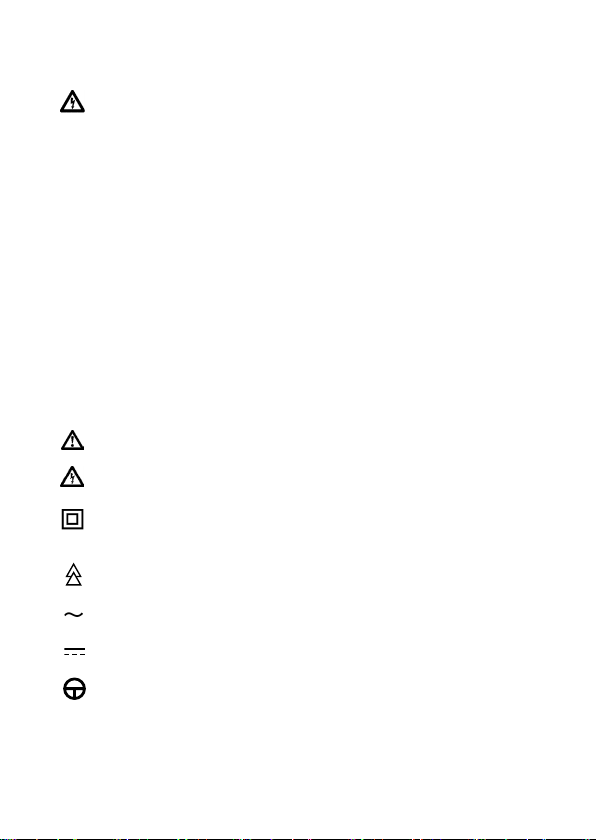
2.1 Meaning of Symbols and Markings
Caution - risk of danger & refer to instructions
Caution - risk of electric shock
Equipment protected by double or reinforced
insulation (Class II)
Suitable for live working
Alternating current (AC)
Direct current (DC)
ON/OFF (push button)
CAT IV (Measurement Category IV) is applicable to test and
measuring equipment connected at the source of the
building’s low-voltage MAINS installation.

3
For further information on measurement categories refer to page 15
or visit www.martindale-electric.co.uk/measurement_categories.php
Equipment complies with relevant EU Directives
Equipment complies with relevant UK Conformity
Assessed marking
End of life disposal of this equipment should be in
accordance with relevant Directives
ELV Extra low voltage. Voltage below 50V AC or 120V DC
2.2 Precautions
This product has been designed with your safety in mind, but please
pay attention to the following warnings and cautions before use.
Warnings
In order to avoid the danger of electrical shock, it is important that
proper safety measures are taken when working with voltages
exceeding 30V AC rms, 42V AC peak or 60V DC.
Where applicable other safety measures such as the use of
protective gloves, goggles etc. should be employed.
The voltage indicator must only be used by a skilled and competent
person who is familiar with the relevant regulations, the safety risks
involved and the consequent normal safe working practices.
Before each use the voltage indicator should be examined for
damage, cracks, cuts or scratches to the housing, cable and prods.
The cable has black outer and contrasting inner insulation, to allow
damage to the cable to be easily identied. If there is any doubt the
voltage indicator should not be used.

4
Make sure the voltage indicator is dry, clean and free from dust,
grease and moisture while in use to avoid the danger from electric
shock due to surface leakage.
Before and after each use, the voltage indicator must be proven
using a suitable proving device or a known good voltage source.
Do not use the voltage indicator if any expected LED’s fail to
illuminate correctly during proving.
Testing for a voltage that exceeds the specied limits of the voltage
indicator may damage the voltage indicator and may expose the
operator to a shock hazard. Always check the voltage indicator’s
specied limits before use.
The specied measurement category means the voltage indicator
will be safe to the user if connected to a voltage up to 1000V to
earth on a CAT II or CAT III installation and 600V to earth on a
CAT IV installation. It does not mean it can be used to test for a
voltage beyond its maximum specied limits.
If using the voltage indicator in falling rain or damp conditions, the
operator must use additional protection to avoid the danger from
electric shock due to surface leakage.
Select appropriate test prods and secure with captive ring nuts. The
L-shaped test prods should be oriented in one of four directions
using the square location feature before it is secured.
When changing or adjusting the prods, ensure that both prods have
been disconnected from any source of power or other equipment.
Always keep your ngers behind the nger guards. Never touch the
exposed metal prod tips.
The different indicating signals of the voltage indicator (including the
ELV limit indication) are not to be used for measuring purposes.

5
The voltage indicator must not be dismantled or modied in any way
by unauthorized persons. The safety of the voltage indicator cannot
be guaranteed under such circumstances and it must not be used.
Cautions
Avoid severe mechanical shock or vibration and extreme
temperature.
If the voltage indicator has been stored or transported in
temperatures outside its normal operating range it should be given
sufcient time to stabilise in the environment where it is to be
used. An acclimatisation time of at least 2 hours is required prior to
operation of the voltage indicator.
2.3 Safety Advice
Depending on the internal impedance of the voltage indicator there
will be a different capability of indicating the presence or absence of
operating voltage in case of the presence of interference phantom
voltage.
A voltage indicator of relatively low internal impedance, compared
to the reference value of 100 kΩ, will not indicate all interference
voltages having an original voltage value above the ELV level.
When in contact with the parts to be tested, the voltage indicator
may discharge temporarily the interference voltage to a level below
the ELV, but it will be back to the original value when the voltage
detector is removed.
When an indication of voltage present does not appear, it is highly
recommended installing earthing equipment before work.
A voltage indicator of relatively high internal impedance, compared
to the reference value of 100 kΩ, may not permit to clearly indicate
the absence of operating voltage in case of the presence of
interference voltage.

6
When an indication of voltage present appears on a part that
is expected to be disconnected from the installation, it is highly
recommended conrming by another means (e.g. use of an
adequate voltage indicator, visual check of the disconnecting point
of the electric circuit, etc.) that there is no operating voltage on the
part to be tested and to conclude that the voltage indicated by the
voltage indicator is an interference voltage.
A voltage indicator declaring two values of internal impedance
has passed a performance test of managing interference voltages
and is (within technical limits) able to distinguish operating voltage
from interference voltage and has a means to directly or indirectly
indicate which type of voltage is present.
3. INTRODUCTION
3.1 Inspection
Examine the shipping carton for any sign of damage. Inspect the
unit and any accessories for damage. If there is any damage then
consult your distributor immediately.
3.2 Accessories
•2pc. Straight prod
•1pc. L-shaped prod
•Instructions

7
4. OPERATION
4.1 Control Elements and Connections
MTL10
1
5
3
4
2
MTL20
6
6
1 - Instrument body
2 - LED indicator bands
3 - Straight prod
4 - L shaped prod
5 - Probe handle
6 - Switches (MTL20 only)

8
4.2 Description of LED Indicators
400V band
120V band
230V band
50V band
The magnitude of a voltage is indicated by the illumination of LED’s
in four separate bands around the top of the instrument body.
The nominal voltage thresholds of the indicator LED bands are 50V,
120V, 230V and 400V and are marked next to the relevant band.
The indicator LED bands will illuminate when the magnitude of
the voltage source is at a value approaching or greater than the
corresponding marked voltage. For example if the voltage source is
55V AC rms then only the 50V indicator LED band will illuminate, if
450V AC rms all four indicator LED bands will illuminate.
Note: The individual LED indications are not to be used for
measuring purposes.
4.3 Operating Duty Ratio
The voltage indicator should be operated (ON) for a maximum
period of 30 seconds. This should be followed by a recovery period
(OFF) of 4 minutes.
The operating duty ratio is 8 to 1, so if the voltage indicator is only
ON for 2 seconds then the OFF period need only be 16 seconds.
Otros manuales para MTL10
2
Este manual sirve para los siguientes modelos
1
Tabla de contenidos
Otros manuales de Equipo de prueba de Drummond


Manuales populares de Equipo de prueba de otras marcas

SMART
SMART KANAAD SBT XTREME 3G Series Manual de usuario

Agilent Technologies
Agilent Technologies BERT Serial Manual de usuario

Agilent Technologies
Agilent Technologies N3280A Manual de usuario

Vernier
Vernier Go Direct Voltage Manual de usuario

Lifeloc
Lifeloc R.A.D.A.R. Manual de usuario

Fluke
Fluke T5-600 Instrucciones de funcionamiento e instalación


