
DeFelsko PosiTest LPD Manual de usuario


Introduction
Introduction
The PosiTest Low voltage Pinhole (Porosity) Detector (LPD) is a
handheld electronic instrument designed to locate small defects and
discontinuities (called “pinholes” or “holidays”) in a protective
coating system applied to a conductive substrate. Fundamentally,
the PosiTest LPD consists of a power source, a ground wire, a
probing electrode (a moistened sponge) and a multi-function LED
display.
In use, an operator moves the moistened sponge (electrode) over
the coated surface. When a pinhole is encountered, current flows
from the sponge through the moisture in the hole and into the
substrate below. The current is returned to the detector through the
attached ground wire, completing the circuit and triggering audible
and visible alarms.
To perform its intended function, a coating must be applied as a
continuous film. Pinhole (holiday) detection is useful for locating
pinholes, holidays, cracks, etc. which are not readily visible. Low
voltage pinhole detectors are commonly used to inspect non-
conductive coatings thinner than 500 µm (20 mils) applied to
conductive substrates.
DeFelsko recommends that the operator read and
fully understand this manual prior to using the PosiTest LPD.
This equipment generates voltage. Accidental contact
with the electrode may result in a mild electric shock. The PosiTest
LPD operator should exercise all due care to minimize their risk of
electric shock and be aware of all relevant safety guidelines before
operating this equipment.
1
WARNING:
IMPORTANT:
2
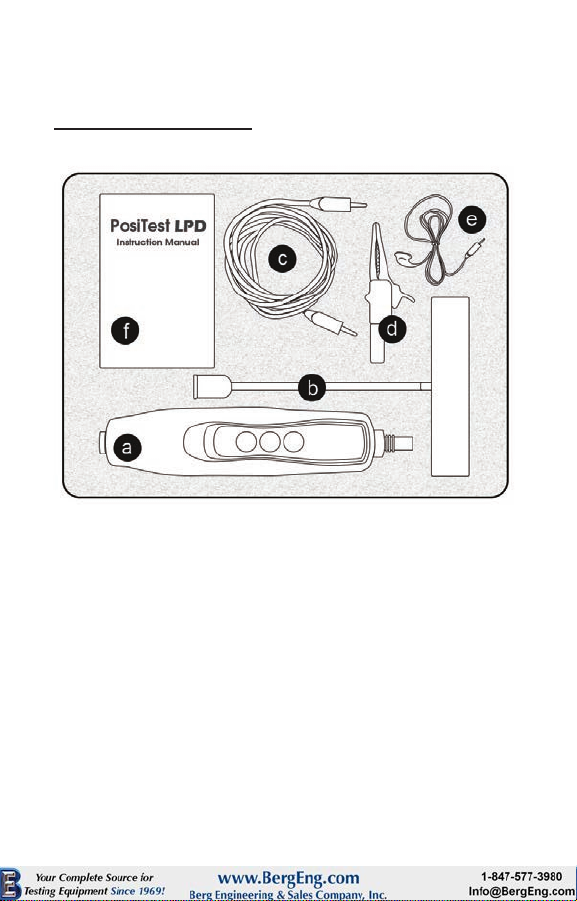
The PosiTest LPD is available in two kit configurations, Basic and
Complete.
PosiTest LPD Basic Kit
The PosiTest LPD Basic Kit includes the following materials:
[a] PosiTest LPD detector with 3 AAA alkaline batteries (installed)
[b] 0.2 m (8”) base tube, rectangle sponge with hardware and
insulating collar (assembled)
[c] 4.5 m (15’) ground (earth) wire
[d] Detachable ground clip
Wrist Strap (not shown)
[e] Wired earbud
[f] Instruction Manual
[g] Long Form Certificate of Calibration traceable to NIST
[h] Small hard shell case

3
PosiTest LPD Complete Kit
The PosiTest LPD Complete Kit includes all materials contained in
the Basic kit plus the following:
The above items are available individually or together in
the PosiTest LPD Accessory Pack (includes items [i] to [v]). See
Accessories on pg. 8.
NOTE:
[i] 12 m (40’) ground wire with
spool
[j] Magnetic ground (earth) clamp
[k] 4.5 m (15’) hot wire (pg.10)
[l] Universal thread adapter (pg. 10)
[m] ACME thread adapter (pg. 10)
[n] oller sponges with hardware
(pg. 10)
[o] 0.3 m (1’) Extension tube (2)
[p] Extension adaptor
[q] Carabiner
[r] 20 cm x 20 cm (8” x 8”) flat
customizable sponge (pg. 11)
[s] ound washers (pg. 11)
[t] Hook & loop fastener wire
ties
[u] Wetting agent
[v] Large hard shell case

4
Assembly Instructions
Assembly Instructions
The base tube and rectangular sponge arrive pre-assembled in both
the PosiTest LPD Basic and Complete kits.
To attach the base tube to the detector body, perform the following
steps:
1. Slide the connector end of the base tube onto the threaded
electrode connector on the PosiTest LPD.
2. Check the alignment of the rectangular sponge and rotate to a
horizontal position.
3. Move the insulating collar to the base of the tube, engage it
with the threaded electrode connector and firmly tighten the
insulating collar.
The materials included with the PosiTest LPD Complete
kit (pg. 3) provide an operator with a wide variety of assembly
options for different inspection situations.
PosiTest LPD (bottom panel)
NOTE:
Threaded electrode connector
Base tube
Insulating collar
Battery compartment
Headphone jack
Ground (earth) wire jack
Carabiner / wrist strap
loop

5
Operating Instructions
Operating Instructions
The PosiTest LPD is typically used on coatings with a measured
thickness less than 500 µm (20 mils). Before performing an
inspection, ensure that the coated surface is fully cured, dry and
free of contaminates.
1. Use clean tap water to wet the test sponge. Squeeze excess
water from the sponge until it no longer drips.
If testing a coating thicker than 250 µm (10 mils), adding a
wetting agent or other low-sudsing surfactant to the water will
reduce the surface tension of the water and promote flow into
discontinuities.
2. Connect the ground (earth) wire clip to an uncoated point of
the part to be tested. Plug the ground wire into the ground wire
jack at the bottom of the PosiTest LPD.
3. Press the Power button to power-up the unit. A self-test is
performed on power-up (pg. 6).
If not using the supplied earbud, press the Audio Alarm
button to activate the audible alarm.
4. Use the Voltage Selector button (pg. 7) to set the required
test voltage.
5. Check correct operation and alarm status by touching the
sponge to the ground clamp or another uncoated point on the
part. This should complete the electrical circuit and trigger the
LED and audio alarms. If no alarm is noted, check all
connections, wires, battery life indicator and sponge wetness.
6. Place the sponge on the coated surface and ensure the
GroundSense™ coupled indicator LED (pg. 7) remains
illuminated and does not blink. If the LED blinks, do the
following:
• Check the ground wire connections at the ground clamp and
detector.
• Attach the ground clip to a different uncoated area on the
part.
TIP:
TIP:

7. Move the sponge over the coated surface at a maximum rate of
0.3 m/s (1 ft/s) and apply sufficient pressure to maintain a wet
surface. If the sponge contacts a pinhole in the coating, all
display LEDs will illuminate and an alarm tone will sound. Alarm
will stop when the sponge is moved away from the pinhole.
8. Precisely locate the pinhole by using a corner of the sponge.
Sponge life depends on use and the abrasive nature of the
surface being tested. Replacement sponges are available with a
comprehensive selection of Accessories (see pg. 8)
PosiTest LPD Control Panel
Buttons:
Power
• Press once to power-up the detector. A self-
test of the 4 test voltages is performed. This
is indicated by a fast flash of each voltage
setting indicator. The self-test should take
approximately 2 seconds to compete. If the
self-test fails, the detector will flash all the
LEDs, sound the alarm then power off.
To conserve battery life, the PosiTest
LPD automatically turns OFF after 5 minutes of no
activity.
•Press and briefly hold to check the battery
status on the LED display.
•Press and hold for 3 seconds to power-down.
Selected Voltage and Audio Alarm settings
are retained.
The self-test can fail if performed while
the sponge/base tube is in contact with a
grounded surface.
6
NOTE:
NOTE:
NOTE:

7
Voltage Selector
• Press repeatedly to cycle through the 4 test voltage settings.
The LED display indicates the currently selected voltage.
Audio Alarm
• Press once to enable the audible alarm, press again to disable.
A green LED illuminates next to the Audio Alarm button when
the alarm is enabled.
The headphone jack is always active.
LED Display:
The four LEDs at the top of the PosiTest
LPD serve multiple functions:
1. Voltage indication
(9V, 67.5V 80KΩ, 67.5K 90KΩ, 90V)
2. Battery state indication – Press and briefly hold the Power
button to check battery status. New, fully charged batteries will
illuminate all four LEDs. Batteries should be changed/recharged
when only one LED illuminates (pg. 12).
3. Pinhole/holiday indication – When a discontinuity is detected,
all LEDs illuminate.
4. Voltage self-test on power-up – See Power button (pg. 6)
5. GroundSense - Successful low voltage pinhole detection
requires that the detector be grounded (earthed) to the test
substrate. If not properly grounded, or if the connection to
ground is lost, the detector will not alarm when a pinhole is
encountered. GroundSense is designed to assure the PosiTest
LPD operator that the detector is grounded while testing.
• The selected voltage LED stays lit when the wet sponge on the
PosiTest LPD is in contact with the coated surface and the
detector is properly grounded.
• When the wet sponge is removed from the coated part, or if the
connection to ground is lost, the selected voltage LED will blink.
NOTE:

8
For example, when a PosiTest LPD operator prepares to test for
coating pinholes on a steel beam he/she first connects the ground
clamp and 4.5 m (15’) ground wire to an uncoated area of the beam.
When the detector is powered-up, GroundSense causes the LED
for the selected voltage to blink until the operator couples the wet
sponge by placing it on the coated beam. When the wet sponge is
lifted from the coated beam, GroundSense causes the LED for the
selected voltage to blink. The LED will also blink if the ground clamp
is accidentally removed from the beam while the wet sponge is in
contact with the beam.
If the 12 m (40’) ground wire is laid near a conductive (i.e.
concrete or metal), grounded surface during testing, it may cause
GroundSense to falsely indicate a coupled condition after the wet
sponge is removed from the coated part. If GroundSense indicates
a coupled condition before the operator contacts the wet sponge to
the coated surface, its indications should be ignored. GroundSense
is for advisory use only, and does not replace the operator’s
responsibility to ensure that the detector is properly grounded.
Accessories
Accessories
A variety of accessories are available to help you get the most out
of your PosiTest LPD.
For a complete list of accessories see: www.defelsko.com/lpd
Item Order Code
Rectangular sponges (3) LPDSPONGESPK
Roller sponges (12) LPDSPONGERPK
20 cm x 20 cm (8” x 8”) flat
customizable sponge LPDSPONGECPK
Wetting agent (2) LPDWET
Accessory Pack - contains items
[i] to [v] as shown on pg. 3 LPDACCPK
NOTE:

9
Customization Options
(using items included with PosiTest LPD Complete kit or
Accessory pack)
Roller Sponge
The roller sponge may be preferred when testing over a large
surface area.
Attach the roller sponge to the base tube and PosiTest LPD.
1. Remove the rectangular sponge from the base tube (if
connected) by rotating it counterclockwise.
2. Attach the roller sponge to the base tube by rotating it
clockwise until tight.
3. Connect the base tube to the PosiTest LPD.
Replacement sponges are available (see Accessories, pg. 8)
Extending the length of the base tube
Extension Tubes
Extend the base tube an additional 0.6 m (2’) using the (2)
extension tubes.
Threaded electrode connector
Roller sponge
Base tube
Insulating collar
Base tube
Extension tube
Rectangular sponge
Otros manuales para PosiTest LPD
1
Este manual sirve para los siguientes modelos
1
Tabla de contenidos
Idiomas:
Otros manuales de Sensor de seguridad de DeFelsko


