
CO/Tech S1M-KZ5-125B-UK Manual de usuario

ENGLISHSVENSKANORSKSUOMI
Important!
Read the entire instruction manual carefully
and make sure that you fully understand
it before you use the equipment. Keep the
manual for future reference.
Viktig information:
Läs hela bruksanvisningen noggrant och
försäkra dig om att du har förstått den innan
du använder utrustningen och spara den för
framtida bruk.
Viktig informasjon:
Les disse anvisningene nøye og forsikre deg
om at du forstår dem før du bruker enheten
og oppbevar dem for senere bruk.
Tärkeätä tietoa:
Lue nämä ohjeet huolellisesti ja varmista
että olet ymmärtänyt ne, ennen kuin alat
käyttää laitetta. Säilytä ohjeet myöhempää
tarvetta varten.
Vinkelslipmaskin
Vinkelslipemaskin
Kulmahiomakone
Art.no. Model
18-3072 S1M-KZ5-125B-UK
30-9315 S1M-KZ5-125B
Angle Grinder
Ver. 200809


3
ENGLISH
Angle grinder
Art.no.: 18-3072 Model: S1M-KZ5-125B-UK
30-9315 S1M-KZ5-125B
Please read the entire instruction manual before using and save it for future use.
We apologise for any text or photo errors and any changes of technical data.
If you have any questions concerning technical problems please contact our
Customer Service Department (see address on reverse.)
Contents
Safety 3
Product description 11
Assembly 12
Use 13
Care and maintenance 13
Troubleshooting table 13
Disposal 14
Specifications 14

4
ENGLISH
1. General safety instructions
Warning! Read all the instructions. Failure to adhere to the following instructions
may lead to electric shocks, fires and/or serious injury. The term “electrical hand
tools” in the warning text below is referring to your mains operated or battery
operated hand tool.
SAVE THE INSTRUCTIONS.
The work space
a) Keep the work space clean and well illuminated. Cluttered and poorly lit
areas invite accidents.
b) Do not use electrical hand tools in explosive environments, i.e. nearby
ammable liquids, gas or dust. Electrical hand tools generate sparks that
could easily ignite dust or fumes.
c) Keep away from children and other spectators while using the electrical
hand tool. Distractions can make you lose your concentration and control.
Electrical safety
a) The electrical hand tool’s plug must t correctly in the wall socket. Never
modify the plug in any way. Never use an adaptor together with earthed
electrical hand tools. Unmodied plugs and suitable wall sockets decrease the
risk of electric shock.
b) Avoid body contact with earthed objects, such as pipes, radiators, ovens or
refrigerators. There is an increased risk of electrical shock if your body is earthed.
c) Do not expose the electrical hand tool to rain or other wet conditions. If
water gets inside an electrical hand tool it increases the risk of electrical shock.
d) Do not misuse the lead. Never use the lead to carry, drag or pull the plug
out of the wall socket. Keep the lead away from heat, oil, sharp edges and
movable parts. Damaged or tangled leads increase the risk of electrical shock.
e) When you use an electrical hand tool outdoors; use an extension
cord suitable for this purpose. Use of an extension cord for outdoor use
decreases the risk of electrical shock.
Personal safety
a) Pay attention to what you do and use common sense when using
electrical hand tools. Never use an electrical hand tool if you are tired or
under the inuence of drugs, alcohol or medication. One moment of not paying
attention while using an electrical hand tool may result in serious injury.

5
ENGLISH
b) Use protective equipment. Always use safety glasses. Using protective
equipment such as a face mask, slip resistant protection shoes, a helmet and
ear defenders when needed decreases the risk of injury.
c) Avoid unexpected start. Make sure that the switch is set to OFF before
you connect the device to the wall socket. Never carry an electrical hand
tool with one nger on the trigger or never connect the hand tool to a wall
socket when the switch is set to ON, since it may result in injury.
d) Remove all service tools/keys before switching on the hand tool. A forgotten
service tool on a rotating part of the electrical hand tool may result in injury.
e) Do not overreach. Make sure you stand steady and well balanced at all
times. This gives better control in unexpected situations.
f) Wear suitable clothing. Do not wear loose tting clothes or jewellery.
Keep hair, clothes and gloves away from movable parts. Loose tting
clothes, jewellery or long hair could get caught in movable parts.
g) If the equipment for suctioning or collecting dust is available make sure
it is connected and used properly. Using technical aids may reduce dust
related hazards.
Use and maintenance of the electrical hand tools
a) Do not overdrive the hand tool. Use a hand tool suitable for the work you
are to perform. At the correct rate of feed, the correct tool will carry out the
work better and more safely.
b) Never use the electrical hand tool if the switch does not work properly
to turn on and shut off the tool. All electrical hand tools that can not be
operated by the switch are dangerous and must be repaired.
c) Unplug the lead from the wall socket before making any adjustments,
changes of accessories or storing the electrical hand tool away. These
precautions reduce the risk of unexpected start of the electrical hand tool.
d) Store electrical hand tools that are not being used out of reach from
children. Do not let people unfamiliar with the electrical hand tool or its
instructions use it. Electrical hand tools can be dangerous if they get into the
hands of inexperienced users.
e) Maintenance of electrical hand tools. Check if something is incorrectly
set, if movable parts are getting jammed, or parts are broken or
something else that might cause the electrical hand tool to malfunction.
If something is damaged it must be repaired before use. Many accidents are
caused by poorly maintained electrical hand tools.
f) Keep the tools sharp and clean. Properly maintained cutting tools with sharp
blades are less likely to jam and are easier to control.

6
ENGLISH
g) Use the electrical hand tool, accessories and such according to the
instructions and in a way suitable for the type of electrical hand tool
used. Using the electrical hand tool for work other than that for which it is
intended could result in a dangerous situation.
Service
a) Repairs and service should only be performed by qualied persons, and
only with original spare parts. This guarantees the safety of the electrical
hand tool.
2.Special safety warnings concerning
grinding, dressing, brushing, or cutting
a) This hand-held power tool is intended for grinding, dressing, brushing,
and cutting. Read all the safety warnings, instructions, illustrations, and
specications, which are included with this tool. Neglecting to follow all the
instructions below can result in electric shock, re, and/or serious injury.
b) Polishing is not recommended using this hand-held power tool. Using this
hand-held power tool to perform work for which it was not intended can lead to
dangerous situations and personal injury.
c) Do not use accessories, which are not especially intended and
recommended by the power tool manufacturer. Even if the accessory can be
mounted on your electric tool, there is no guarantee that it will be safe to use.
d) The rated speed of the accessory must at least correspond to the
maximum speed marked on the angle grinder. Accessories, which rotate
faster than their rated speed, can shatter or break.
e) The outer diameter and thickness of the accessory must be within the
rated capacity of your angle grinder. An incorrectly sized accessory cannot
be secured or controlled correctly.
f) The size of the spindle holes on the discs, anges, and backing plates
or other accessory must t the spindle on your angle grinder correctly.
Accessories having the incorrect spindle size will end up out of balance,
vibrate violently, and can lead to loss of control.
g) Do not use a defective accessory. Inspect the accessory and see if there
are any chips or cracks on the grinding discs; cracks or wear and tear
on the backing plates, or loose or torn threads on the steel brush discs.
If you drop the angle grinder or an accessory, check to see if there is any
damage; if so t an undamaged accessory. After inspection and tting of an
accessory, place yourself and others outside of the machine’s danger area and
let the power tool run at full speed for one minute. Damaged accessories will
normally break during this test period.

7
ENGLISH
h) Wear personal protective equipment. Depending on how you use the
machine, use face protection or protective glasses. According to need
use a mask, ear protection, gloves and work clothing, which protect
against small debris or splinters from the work object. Eye protection
should be able to protect against ying debris, which is produced at different
speeds. Breathing protection should able to lter particles, which are produced
by the work. Longer exposure to noise can result in hearing damage.
i) Keep others at an appropriate distance from the place of work. All who
visit the place of work must wear personal protective equipment. Debris
from the object worked upon or from a damaged accessory can become
airborne and result in injury outside of the work’s immediate vicinity.
j) Grip the angle grinder only by the insulated parts of the handle when
working in any area where the cutting disc can come into contact with
hidden cables or its own power lead. Cutting discs, which come in contact
with an electric cable can electrify exposed metal parts of the hand tool and
electrocute the user.
k) Keep the power lead at a distance from the rotating accessory. If you lose
control, the lead can get cut or get stuck and your hand or arm can get pulled
into the rotating accessory.
l) Never put the angle grinder down before the accessory has stopped
completely. The rotating accessory can get stuck in the ground and you could
lose control of the tool.
m) Do not run the angle grinder whilst carrying it. Unintentional contact with
the rotating accessory can result in it getting caught in your clothing and pulling
the tool against your body.
n) Clean the motor’s ventilation openings regularly. The motor’s fan attracts
dust, which gets in under the outer casing and any metal dust which is
collected can lead to electrical hazards.
o) Do not use the angle grinder near ammable material. Sparks can ignite
this material.
p) Do not use accessories, which require liquid coolants. Usage of water or
other liquid coolants can result in electric shocks or electrocution.

8
ENGLISH
Kick-backs and their warnings
A throw is a sudden reaction to a wedged or stuck disc, backing plate, brush, or A
kick-back is a sudden reaction from a jammed or stuck disc, backing plate, brush,
or some other accessory. Jamming or getting stuck results in a quick stop of the
rotating accessory, which makes the electric tool rotate in the opposite direction.
For example, if a grinding disc gets stuck or is wedged in the object, the edge of
the grinding disc can grab onto the object and cause the grinding disc to dig itself
down or be kicked back. The grinding disc is either kicked back towards the user
or away from the user depending on the direction of rotation of the grinding disc,
when it gets stuck. The grinding discs can also break under these circumstances.
Kick-backs are the result of the electric tool being used in an incorrect manner, on
unsuitable objects, or under unfavourable conditions and can be avoided by ob-
serving the precautions below.
a) Hold the electric tool steadily and keep your arms and body so that you
can brace against kick-backs. Always use the handle grip if there is one
for maximum control against kick-back or recoil to the torque at start-up.
Kick-backs or reactions to torque can be controlled by the user if the required
safety precautions are observed.
b) Never place your hand near the rotating accessory. The accessory can
kick back over your hand.
c) Do not stand in the area, where the electric tool could possibly land if
a kick-back were to take place. A kick-back forces the tool in the opposite
direction to the grinding disc’s rotation.
d) Be extra careful, when working with corners, sharp edges, etc. Avoid
bouncing and getting the accessory stuck. Corners, sharp edges, and
bouncing have a tendency to get the rotating accessory stuck and lead to loss
of control of the tool.
e) Never attach a toothed saw blade for wood cutting. Such blades can cause
you to lose control and frequently lead to accidents.
Specific safety warnings for grinding and cutting using a cutting disc
a) Use only disc types, which are recommended for the angle grinder in
question and tted with a special safety guard intended for the selected
cutting disc. Discs, which are not intended for the electric tool cannot be
protected correctly and can be dangerous.
b) The safety guard must be attached onto the power tool in a safe manner
and installed for maximum safety so that the user is exposed to the disc
as little as possible. The safety guard helps to protect the user from shattered
discs and unintentional contact with the disc.

9
ENGLISH
c) The discs may only be used with the recommended torque. For example:
Do not grind with the face of the cutting disc. Cutting discs are intended for
grinding using the edge of the disc. If they are exposed to force on the face,
they can break.
d) Always use undamaged anges of the correct size and shape for the
selected disc. Correct anges support the disc and minimize the risk of it
breaking. Flanges for cutting discs can be different from those which are used
for grinding discs.
e) Never use worn-down discs from a larger angle grinder. Discs intended
for larger angle grinders are not compatible with smaller angle grinders which
rotate at higher speeds, and can break.
Additional safety warnings especially for cutting using a cutting disc
a) Do not strain the cutting disc or apply too much pressure. Do not try to
cut too deeply. Overexerting the disc increases the strain and the possibility
of the disc twisting and getting stuck in the cut and thus increasing the risk of
kick-backs or the disc breaking.
b) Never stand in line with or behind the rotating disc/accessory. When the
disc moves towards you during use, a kick-back can force the rotating disc and
the angle grinder towards you.
c) If the disc gets stuck or if you want to abort a cut for any reason, turn off
the angle grinder and hold it still until the disc has stopped completely.
Never try to remove the cutting disc from the cut while the disc is moving
since it can result in a kick-back. Observe the necessary measures to
minimize the risks of the cutting disc getting stuck.
d) After stopping do not restart cutting with the disc in the workpiece. Let
the disc reach full speed rst and then continue carefully to lower the
disc into the cut. The disc can get stuck, wander out of the cut, or cause kick-
backs if cutting is restarted whilst still in the workpiece.
e) Support large sheets or other large workpieces in order to minimize the
risk of the disc getting stuck or kick-backs. Large sheets of material tend
to sag due to their own weight. Support must be placed under the workpiece
close to the cutting line and close to the edge of the workpiece on both sides of
the cutting disc.
f) Be extra careful with plunging (cutting) into walls or other objects, where
vision is obstructed. The protruding cutting disc could cut into gas or water
pipes, electric cable, or other objects resulting in kick-backs.
10
ENGLISH
Safety warnings especially for dressing
a) Do not use abrasive discs which are too large. Follow the manufacturer’s
recommendations when selecting discs. Larger abrasive discs, which stick
out of the support disc carry the risk of wearing out and can result in the disc
getting stuck, breaking or resulting in kick-backs.
Safety warnings especially for steel brushing
a) Remember that the brush can come loose from the steel brush disc even
during normal use. Do not overexert the brush disc by applying too much
pressure. Loose brush threads can easily penetrate thin clothing or skin.
b) If a safety guard is recommended for steel brushing, make sure that the
brush disc does not touch the guard. The steel brush disc can expand from
contact with the workpiece or from centrifugal force.
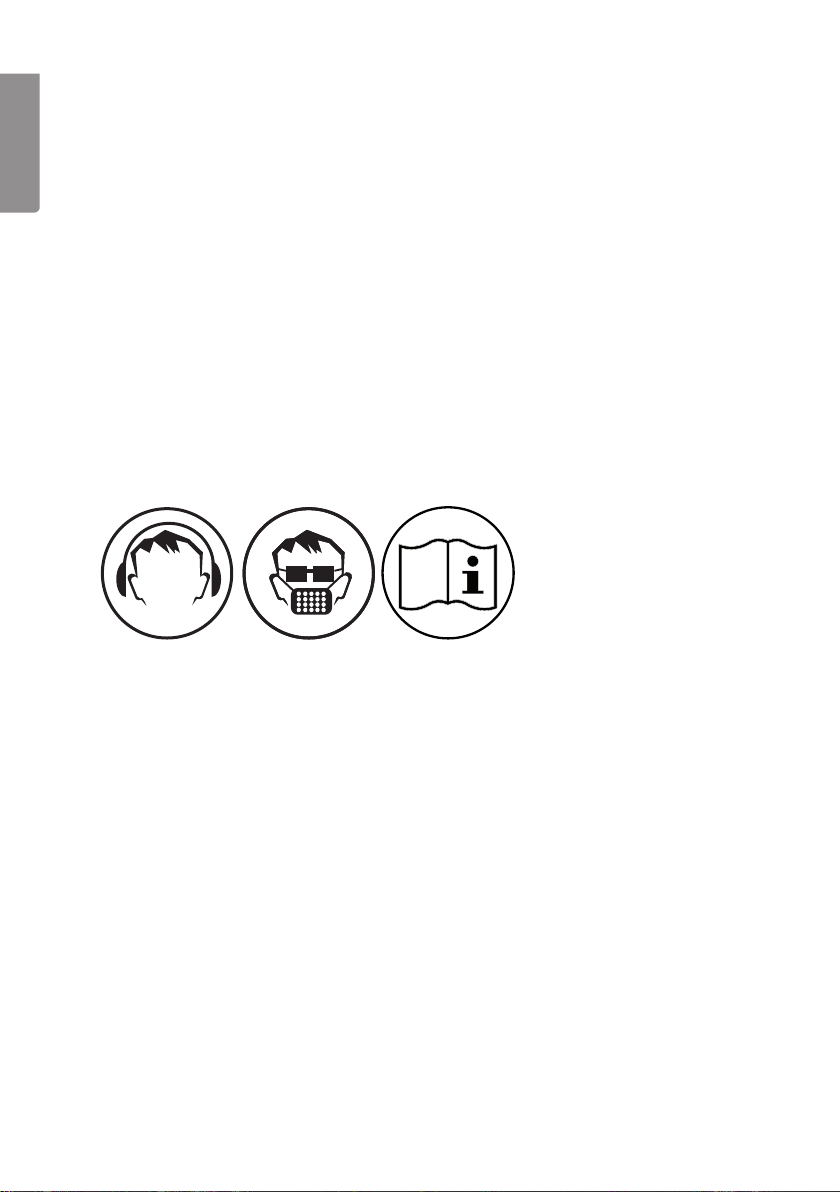
• Use ear protection.
• Use glasses or visor and breathing protection.
• Read the entire manual before use and save it for future reference.
Safety symbols
Este manual sirve para los siguientes modelos
3
Tabla de contenidos
Idiomas:
Otros manuales de Amoladora de CO/Tech


