4
There should be no more than 4 bends in a system. (A 90° Tee on
the back of the stove counts as 2 bends). If four bends are used
there should be sweeping access between the two offsets.
There should be no flue joins between a floor or ceiling joists or
rafters, with at least 150mm twin-wall flue projecting below and
above before an additional connection with twin wall.
The flue must not go more than 45° off vertical.
The minimum recommended height from top of stove to termination
is 4.5metres, however many stoves will run on a shorter flue.
The minimum flue size for non defra approved stoves is 150mm.
The flue size must NEVER be smaller than the appliance outlet,
unless approved by stove manufacturer.
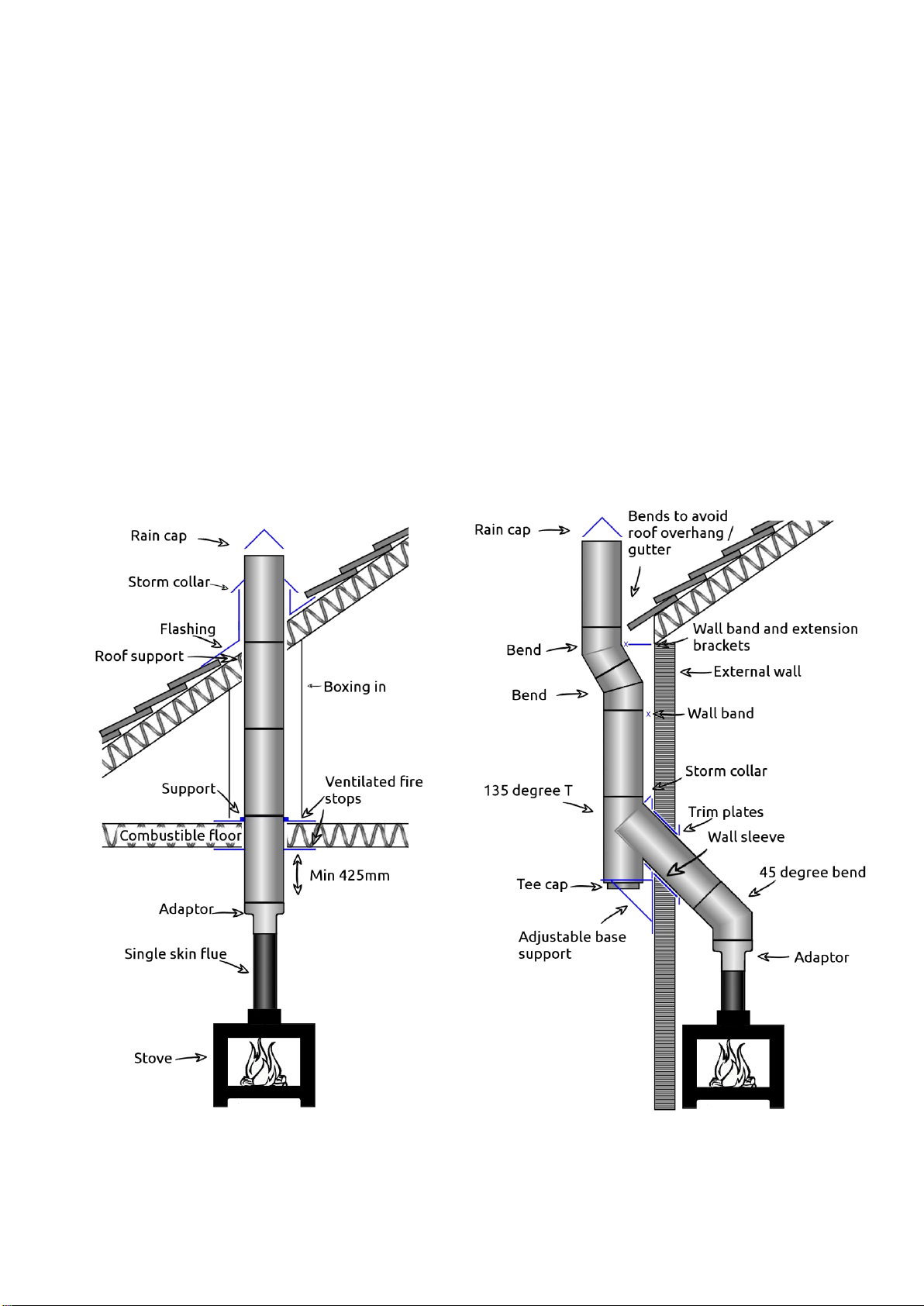
Flue needs to switch from single skin to twin wall at 425mm below a
ceiling.
Where the chimney passes through any part of the building, (with
the exception of the room where the appliance is installed), where
there is a risk of accidental human contact, i.e a bedroom etc., or
where there is a risk of contact with combustible materials, the
chimney must be enclosed in an appropriate way to meet Building
Regulations. This can be achieved by boxing-in the chimney, or by
the use of a protective wire mesh frame in roof spaces etc. The
minimum distance of 50mm to any combustible material, including
loft insulation should always be observed and any enclosure should
be ventilated using the appropriate ventilated fire stops.
Twin wall should also be boxed-in in attic spaces. This can be
achieved with wire mesh to a minimum of 1200mm in height.
Single skin flue should be 3 times its diameter from combustible
material if not heat shielded. (i.e. 150mm pipe should be 450mm
from combustible materials).
It is recommended that the maximum horizontal offset should not
exceed 20% of the total length of the chimney.
All offsets should be supported above and below with the
appropriate support component i.e. ceiling, joist, wall or roof
support.
It is recommended that a vertical run of at least 600mm should be
allowed immediately above the appliance prior to any change of
direction.
To allow for expansion as the stove heats up, it is important that the
weight of the flue system is not carried by the appliance. If the
chimney is built from the stove upwards then the flue lengths must
be raised by 3-5mm before the supports are fixed. A common
practice would be to use small combustible packers (eg. folded
cardboard) placed in the flue spigot to sit the first length or adaptor
on. When the stove is lit these will burn away while the fire-cement
sets.
Twin wall lengths are designed to be assembled without the use of
any jointing compound.