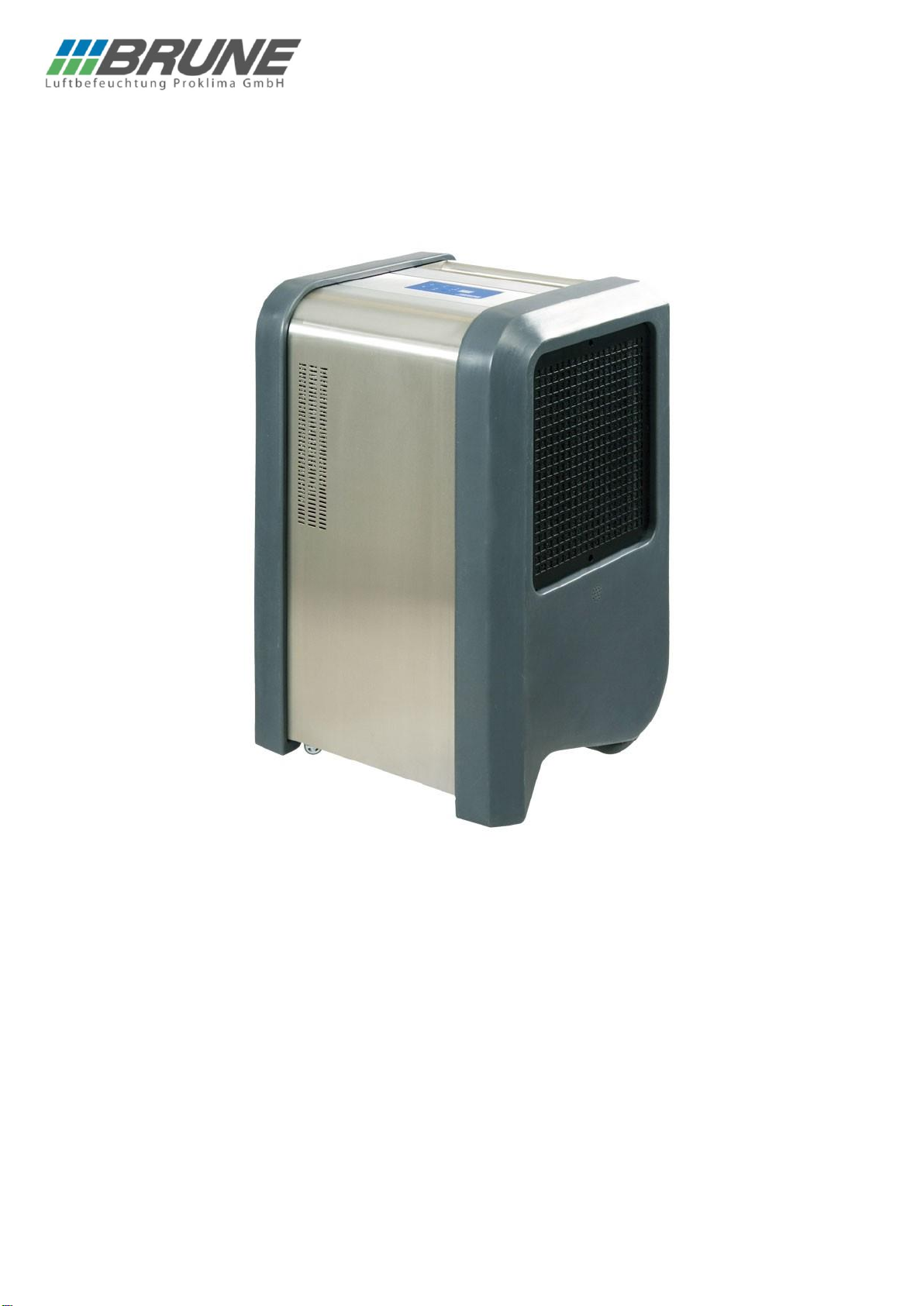
Brune HP50 Manual de usuario

INSTRUCTIONS MANUAL [EN]
HP50

CONTENTS
PAGE
1. GENERAL SAFETY INFORMATION ............................................................................................................................... 1
2. APPLIANCE RELEVANT SAFETY INFORMATION......................................................................................................... 13
3. GENERAL ADVICE ...................................................................................................................................................... 15
4. DEHUMIDIFIER PRINCIPLES....................................................................................................................................... 15
5. INSTALLATION AND TRANSPORTATION.................................................................................................................... 15
6. OPERATING INSTRUCTIONS...................................................................................................................................... 16
7. ELECTRONIC CONTROL ............................................................................................................................................. 17
8. AUTOMATIC DEFROSTING SYSTEM .......................................................................................................................... 20
9. WORKING MODE WITH CONDENSATE PUMP (OPTION) .......................................................................................... 20
10. ELECTRICAL CONNECTIONS .................................................................................................................................... 21
11. OPERATING CONDITIONS ....................................................................................................................................... 21
12. SPECIFICATIONS...................................................................................................................................................... 21
13. TROUBLESHOOTING................................................................................................................................................ 22
14. MAINTENANCE........................................................................................................................................................ 23
15. ELECTRIC DIAGRAMS .............................................................................................................................................. 24
16. EXPLODED VIEW ..................................................................................................................................................... 25
17. SUBASSEMBLIES...................................................................................................................................................... 25
18. DISPOSAL ................................................................................................................................................................ 26

1 [EN]
1. GENERAL SAFETY INFORMATION
The operator must provide the user with the operating
instructions and ensure that the user understands the
contents.
-The appliance contains a mildly flammable
refrigerant.
-This is a blend of a mildly flammable (A2L) and
a fluorinated (A1) refrigerant.
-Read the supplied instructions/warnings.
-Read the service manual.
-Read the operators manual.
This appliance can be used by children aged from 8 years and above
and persons with reduced physical, sensory or mental capabilities
or lack of experience and knowledge if they have been given
supervision or instruction concerning use of the appliance in a safe
way and understand the hazards involved.
Children shall not play with the appliance. Cleaning and user
maintenance shall not be made by children without supervision.

2 [EN]
WARNING
Risk of fire/flammable materials
WARNINGS
-Do not use means to accelerate the defrosting process or to clean,
other than those recommended by the manufacturer.
-The appliance shall be stored in a room without continuously
operating ignition sources (for example: open flames, an
operating gas appliance or an operating electric heater).
-Do not pierce or burn.
-Be aware that the refrigerants may not contain an odour.
-Appliance should be installed, operated and stored in a room with
a floor area larger than 4 m².
-Compliance with national gas regulations shall be observed.
-R290 has a low GWP (Global Warming Potential) of 3 and an ODP
(Ozone Depletion Potential) of 0.
-The maximum refrigerant charge amount: 0,150 kg.
-Keep ventilation openings clear of obstruction.
-The appliance shall be stored so as to prevent mechanical damage
from occurring.
-A warning that the appliance shall be stored in a well-ventilated
area where the room size corresponds to the room area as
specified for operation.

3 [EN]
-Any person who is involved with working on or breaking into a
refrigerant circuit should hold a current valid certificate from an
industry-accredited assessment authority, which authorizes their
competence to handle refrigerants safely in accordance with
industry’s recognized assessment specification.
-Servicing shall only be performed as recommended by the
equipment manufacturer. Maintenance and repair requiring the
assistance of other skilled personnel shall be carried out under
the supervision of the person competent in the use of flammable
refrigerants.
-
INFORMATION ON SERVICING
1. Checks to the area
Prior to beginning work on systems containing flammable
refrigerants, safety checks are necessary to ensure that the risk of
ignition is minimized. For repair to the refrigerating system, the
following precautions shall be complied with prior to conducting
work on the system.
2. Work procedure
Work shall be undertaken under a controlled procedure so as to
minimize the risk of a flammable gas or vapour being present while
the work is being performed.
3. General work area
All maintenance staff and others working in the local area shall be
instructed on the nature of work being carried out. Work in
confined spaces shall be avoided. The area around the workspace
shall be sectioned off. Ensure that the conditions within the area
have been made safe by control of flammable material.

4 [EN]
4. Checking for presence of refrigerant
The area shall be checked with an appropriate refrigerant detector
prior to and during work, to ensure the technician is aware of
potentially flammable atmospheres. Ensure that the leak detection
equipment being used is suitable for use with flammable
refrigerants, i.e. non-sparking, adequately sealed or intrinsically
safe.
5. Presence of fire extinguisher
If any hot work is to be conducted on the refrigeration equipment
or any associated parts, appropriate fire extinguishing equipment
shall be available to hand. Have a dry powder or CO2 fire
extinguisher adjacent to the charging area.
6. No ignition sources
No person carrying out work in relation to a refrigeration system
which involves exposing any pipe work that contains or has
contained flammable refrigerant shall use any sources of ignition in
such a manner that it may lead to the risk of fire or explosion. All
possible ignition sources, including cigarette smoking, should be
kept sufficiently far away from the site of installation, repairing,
removing and disposal, during which flammable refrigerant can
possibly be released to the surrounding space. Prior to work taking
place, the area around the equipment is to be surveyed to make
sure that there are no flammable hazards or ignition risks. No
Smoking signs shall be displayed.
7. Ventilated area
Ensure that the area is in the open or that it is adequately ventilated
before breaking into the system or conducting any hot work. A
degree of ventilation shall continue during the period that the work

5 [EN]
is carried out. The ventilation should safely disperse any released
refrigerant and preferably expel it externally into the atmosphere.
8. Checks to the refrigeration equipment
Where electrical components are being changed, they shall be fit
for the purpose and to the correct specification. At all times the
manufacturer's maintenance and service guidelines shall be
followed. If in doubt consult the manufacturer's technical
department for assistance.
The following checks shall be applied to installations using
flammable refrigerants:
-The charge size is in accordance with the room size within which
the refrigerant containing parts are installed;
-The ventilation machinery and outlets are operating adequately
and are not obstructed;
-If an indirect refrigerating circuit is being used, the secondary
circuit shall be checked for the presence of refrigerant;
-Marking to the equipment continues to be visible and legible.
Markings and signs that are illegible shall be corrected;
-Refrigeration pipe or components are installed in a position
where they are unlikely to be exposed to any substance which
may corrode refrigerant containing components, unless the
components are constructed of materials which are inherently
resistant to being corroded or are suitably protected against
being so corroded.
9. Checks to electrical devices
Repair and maintenance to electrical components shall include
initial safety checks and component inspection procedures. If a
fault exists that could compromise safety, then no electrical supply
shall be connected to the circuit until it is satisfactorily dealt with.

6 [EN]
If the fault cannot be corrected immediately but it is necessary to
continue operation, an adequate temporary solution shall be used.
This shall be reported to the owner of the equipment so all parties
are advised.
Initial safety checks shall include:
-That capacitors are discharged: this shall be done in a safe
manner to avoid possibility of sparking;
-That there no live electrical components and wiring are exposed
while charging, recovering or purging the system;
-That there is continuity of earth bonding.
Repairs to sealed components
1. During repairs to sealed components, all electrical supplies
shall be disconnected from the equipment being worked upon prior
to any removal of sealed covers, etc. If it is absolutely necessary to
have an electrical supply to equipment during servicing, then a
permanently operating form of leak detection shall be located at
the most critical point to warn of a potentially hazardous situation.
2. Particular attention shall be paid to the following to ensure
that by working on electrical components, the casing is not altered
in such a way that the level of protection is affected. This shall
include damage to cables, excessive number of connections,
terminals not made to original specification, damage to seals,
incorrect fitting of glands, etc.
Ensure that apparatus is mounted securely.
Ensure that seals or sealing materials have not degraded such that
they no longer serve the purpose of preventing the ingress of
flammable atmospheres. Replacement parts shall be in accordance
with the manufacturer's specifications.

7 [EN]
NOTE: The use of silicon sealant may inhibit the effectiveness of
some types of leak detection equipment. Intrinsically safe
components do not have to be isolated prior to working on them.
Repair to intrinsically safe components
Do not apply any permanent inductive or capacitance loads to the
circuit without ensuring that this will not exceed the permissible
voltage and current permitted for the equipment in use.
Intrinsically safe components are the only types that can be worked
on while live in the presence of a flammable atmosphere. The test
apparatus shall be at the correct rating.
Replace components only with parts specified by the manufacturer.
Other parts may result in the ignition of refrigerant in the
atmosphere from a leak.
Cabling
Check that cabling will not be subject to wear, corrosion, excessive
pressure, vibration, sharp edges or any other adverse
environmental effects. The check shall also take into account the
effects of aging or continual vibration from sources such as
compressors or fans.
Detection of flammable refrigerants
Under no circumstances shall potential sources of ignition be used
in the searching for or detection of refrigerant leaks. A halide torch
(or any other detector using a naked flame) shall not be used.

8 [EN]
Leak detection methods
The following leak detection methods are deemed acceptable for
systems containing flammable refrigerants.
Electronic leak detectors shall be used to detect flammable
refrigerants, but the sensitivity may not be adequate, or may need
re-calibration. (Detection equipment shall be calibrated in a
refrigerant-free area.) Ensure that the detector is not a potential
source of ignition and is suitable for the refrigerant used. Leak
detection equipment shall be set at a percentage of the LFL of the
refrigerant and shall be calibrated to the refrigerant employed and
the appropriate percentage of gas (25 % maximum) is confirmed.
Leak detection fluids are suitable for use with most refrigerants but
the use of detergents containing chlorine shall be avoided as the
chlorine may react with the refrigerant and corrode the copper
pipe-work.
If a leak is suspected, all naked flames shall be removed/
extinguished.
If a leakage of refrigerant is found which requires brazing, all of the
refrigerant shall be recovered from the system, or isolated (by
means of shut off valves) in a part of the system remote from the
leak. Oxygen free nitrogen (OFN) shall then be purged through the
system both before and during the brazing process.
Removal and evacuation
When breaking into the refrigerant circuit to make repairs or for
any other purpose conventional procedures shall be used.
However, it is important that best practice is followed since
flammability is a consideration.
The following procedure shall be adhered to:
Remove refrigerant;
Otros manuales para HP50
2
Tabla de contenidos
Otros manuales de Deshumidificador de Brune


