
Atdec A-dec 301 Manual de usuario

Air Motor
000OM-DM0906EN
A-dec 301
INSTRUCTIONS
FOR USE
Please read these Instructions For Use
carefully before use, and file for future
reference. MADE IN JAPAN

1
1 User and Indications for Use
User: Qualified Professionals (Dentist/Dental hygienist)
Indications for Use:
Air Motor is intended for the following application(s):
A connection equipment to transfer energy (rotation, air, water,
light) required for handpieces.
The device is used in combination in tooth restoration,
periodontics and endodontics.
For identification of symbols, refer to the “12.
Symbol” section on page 16 and
Regulatory
Information, Specifications, and Warranty
document (p/n 86.0221.00), which is available in
the Resource Center at www.a-dec.com.
2 Precautions for Handling and Operation
• Please read these precautions carefully and use only as
intended or instructed.
• Safety instructions are intended to avoid potential hazards that
could result in personal injury or damage to the device. Safety
instructions are classified as follows in accordance with the
seriousness of the risk.
Class Degree of Risk
WARNING
Hazard that could result in serious injury or
damage to the device if the safety instructions
are not correctly followed.
CAUTION
Hazard that could result in light or moderate
injury or damage to the device if the safety
instructions are not correctly followed.

2
NOTICE
General product specification information
highlighted to avoid product malfunction and
performance reduction.
WARNING
• Clean and lubricate the motor immediately
(within 1 hour) after each treatment to remove
residue. Failure to properly maintain the motor
may cause infection, product failure or
overheating, leading to burn injuries. (Refer to “7.
Post-use Maintenance”.)
CAUTION
• Read this Instructions For Use before use to fully understand
the product functions and file for future reference.
• When operating the product, always consider the safety of the
patient.
• Users are responsible for the operational control, maintenance
and continual inspection of this product.
• Prior to clinical use, inspect the motor. Check for vibration,
noise and overheating. If any abnormalities are found, stop
using the motor immediately and contact your Authorized
A-dec Dealer. (Refer to “6. Check Before Treatment”.)
• Do not disassemble or alter the motor except as described in
this Instructions For Use.
• Do not allow any impact to the product. Do not drop the
product. Deformation may cause the motor to fail during use.
• Operators and all others in the area must wear eye protection
and a mask when operating this motor.

3
CAUTION
• Should the motor function abnormally during use, stop using
the motor immediately and contact your Authorized A-dec
Dealer.
• Do not use the following fluids to wipe, immerse or clean the
product; strong/super acid water, strong acid/alkaline
chemicals, chlorine containing solutions, solvents such as
benzine or thinner.
• The motor is delivered in a non-sterile condition and must be
autoclaved prior to use.
• Perform regular function and maintenance checks. (Refer to
“9. Periodical Maintenance Checks”.)
• If the motor has not been used for a long period, rotate the
motor and check for noise, vibration and overheating before
use.
• To avoid clinical downtime, A-dec recommends that you keep
a spare to replace one that breaks during treatment.
CAUTION
• U.S. Federal law restricts this device to sale by or on the order
of a licensed physician.
NOTICE
• Repairs of this product are only to be performed by authorized
service technicians according to A-dec requirements. Contact
your Authorized A-dec Dealer if repairs are necessary.
4
3 Preparation for Use
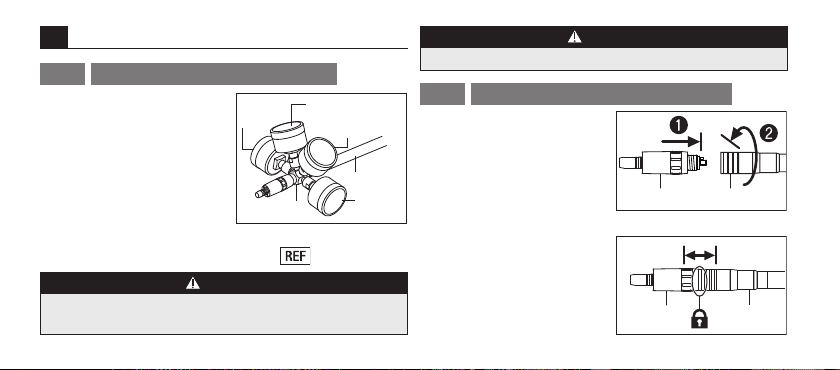
3-1 Setting of Air & Water Supply Pressure
Measure the supply pressure
at the motor/hose connection
point and set the pressure to
the value specified on the
specification table (Fig. 1).
Fig. 1
Chip Air Pressure
Exhaust Air
Pressure
Water
Pressure
Hose
Drive Air
Pressure
Please contact your local dealer for Multi Gauge Z109400.
WARNING
• Do not exceed the optimum pressure specified
on the specification table.
CAUTION
• Do not use air contaminated by dust, moisture or oil.
3-2 Connecting and Disconnecting the Motor
3-2-1 Connecting
1) Insert the motor correctly
into the hose connector
and tighten the hose nut
(Fig. 2).
2) Make sure the motor is
connected firmly to the
hose (Fig. 3).
Fig. 2
Motor Hose Nut
Fig. 3
Motor Hose
Multi Gauge

5
3-2-2 Disconnecting
Loosen the hose nut and
remove the motor from the
hose (Fig. 4).
Fig. 4
Hose Nut
Motor
CAUTION
• If the connection to the hose is loose, the motor may pop out
during treatment, causing injury to the patient’s mouth, face,
etc., and injury to the operator.
4
Connecting and Disconnecting the Handpiece from the Motor
4-1 Connecting
1) Insert the handpiece
directly into the motor (Fig.
5).
2) Confirm that the
handpiece is firmly
connected to the motor.
Fig. 5
Handpiece Motor

6
4-2 Disconnecting
Hold the motor and the handpiece, then pull apart. (Fig. 5)
CAUTION
• Do not connect or disconnect the handpiece until the motor
has completely stopped.
• Make sure that the motor and handpiece are securely
connected. The motor and coolant air pressure may cause
the handpiece to jump out of the motor, which could result
in injury.
• Connect ONLY to E type handpieces (ISO 3964 (EN ISO
3964)).
5 Forward / Reverse Rotation
1) Forward Rotation: Turn the
FWD/REV Change Ring to “F”.
(Fig. 6)
2) Reverse Rotation: Turn the
FWD/REV Change Ring to “R”.
(Fig. 7)
3) When the FWD/REV Change
Ring is positioned at the
middle of “F” and “R” , the
drive air is interrupted and the
motor does not rotate. (Fig. 8)
Fig. 6
Fig. 7
Fig. 8
FWD/REV
Change Ring
“F”: Forward Rotation
“R”: Reverse Rotation

7
6 Check Before Treatment
Follow the check below before use. If any abnormalities are
found, stop using the handpiece immediately and contact your
Authorized A-dec Dealer.
1) Connect the handpiece and make sure that it is securely
connected.
2) Rotate the motor for about one minute at the maximum
rotation speed. During rotation, check for abnormalities such
as abnormal rotation, vibration, noise.
3) After the motor rotation has completely stopped, touch the
motor to confirm there is not heating abnormally.
7 Post-use Maintenance
After each patient, maintain the product as follows.
WARNING
• To ensure cleaning and sterilization efficacy, use
only the following procedures for reprocessing.
• Follow any additional local directives, standards,
and guidelines for cleaning and sterilization.
• Clean and lubricate the motor immediately
(within 1 hour) after each treatment to remove
residue. Failure to properly maintain the motor
may cause infection, product failure, overheating
leading to burn injuries.

8
7-1 Cleaning at point-of use
CAUTION
• Do not use the following liquids to wipe, immerse, or clean
the product: strong/super acid water, strong acid/alkaline
chemicals, chlorine-containing solutions, solvents such as
benzine or thinner.
• Do not immerse A-dec instruments in disinfectant solution
or clean in ultrasonic devices.
1) Always wear protective
gloves, a mask, and
protective goggles for
safety purposes and to
minimize the risk of
infection. (Fig. 9)
Fig. 9
2) Remove the bur. (Fig. 10)
Fig. 10
3) Wipe the exterior of the
handpiece and motor clean
using a cloth moistened
with disinfectant or ethanol
with a concentration of
60-90%. (Fig. 11)
When using disinfectant,
follow the instructions
given by the manufacturer
of the disinfectant.
Fig. 11

9
Use a state-sanctioned disinfectant with proven
bactericidal, fungicidal, and virucidal properties.
The following disinfectants can be used in the United
States and Canada.
CaviCide®, CaviWipes®(manufactured by Metrex)
4) Remove the handpiece
from the motor and remove
the motor from the hose
(Fig. 12).
For reprocessing of the
handpiece, refer to the
Instructions For Use of the
handpiece’s manufacturer.
Fig. 12
Handpiece
Motor
Hose
5) Carry the motor to the
decontamination area.
7-2 Cleaning and Drying
Perform cleaning and drying using the manual or automatic
method.
Manual Method (Cleaning and Drying the Exterior)
Wash the motor under running water following the procedures
below.
(Water condition: ≤100°F (38°C), ≥1 gal/min (3.5L/min);
water should be of the same quality as drinking water)
1) Brush the exterior of
motors under running tap
water using a soft bristled
brush for one minute (Fig.
13).
Fig. 13
2) Rinse the motors under running tap water for 20 seconds.
Tabla de contenidos


