Astria.us.com
126691-01_B 7
AIR FOR COMBUSTION AND VENTILATION
WARNING: This heater shall
not be installed in a room or
space unless the required vol-
ume of indoor combustion air
is provided by the method de-
scribedin theNational FuelGas
Code,ANSIZ223.1/NFPA54, the
International Fuel Gas Code, or
applicablelocalcodes.Readthe
following instructions to insure
proper fresh air for this and
other fuel-burning appliances
in your home.
Today’shomesarebuilt moreenergy efficient
thanever. New materials,increasedinsulation
and new construction methods help reduce
heat loss in homes. Home owners weather
strip and caulk around windows and doors to
keepcoldair outandwarm airin. During heat-
ing months, home owners want their homes
as airtight as possible.
While it is good to make your home energy
efficient, your home needs to breathe. Fresh
air must enter your home.All fuel-burning ap-
pliancesneed freshair forproper combustion
and ventilation.
Exhaust fans, fireboxes, clothes dryers and
fuel burning appliances draw air from the
houseto operate.Youmustprovide adequate
fresh air for these appliances. This will insure
proper venting of vented fuel-burning appli-
ances.
PROVIDING ADEQUATE
VENTILATION
The following are excerpts from National Fuel
Gas Code, ANSI Z223.1/NFPA 54, Air for
Combustion and Ventilation.
All spaces in homes fall into one of the three
following ventilation classifications:
1. Unusually Tight Construction
2. Unconfined Space
3. Confined Space
Information on page 7 through 9 will help you
classify your space and provide adequate
ventilation.
Unusually Tight Construction
Airthat leaksaround doorsand windowsmay
provide enough fresh air for combustion and
ventilation.However, in buildings ofunusually
tightconstruction,you must provideadditional
fresh air.
Unusually tight construction is defined as
construction where:
a. walls and ceilings exposed to outside
atmosphere have a continuous water
vapor retarder with a rating of one
perm (6 x 10-11 kg per pa-sec-m2) or
less with openings gasketed or sealed
and
b. weather stripping has been added on
openable windows and doors and
c. caulking or sealants are applied to
areas such as joints around window
and door frames, between sole plates
and floors, between wall-ceiling joints,
between wall panels, at penetrations
for plumbing, electrical and gas lines
and at other openings.
If your home meets all three criteria above,
you must provide additional fresh air. See
Ventilation Air From Outdoors, page 9.
If your home does not meet all
threecriteria
above, proceed to Determining Fresh-Air
Flow for Firebox Location, page 8.
Confined and Unconfined Space
The National Fuel Gas Code, ANSI Z223.1/
NFPA54 allows two methods for determining
whetherthespaceinwhichthe heater is being
installedisconfinedor unconfined space.The
standardmethod defines a confinedspaceas
a space whose volume is less than 50 cubic
feet per 1,000 Btu per hour (4.8 m
3
per kw)
of the aggregate input rating of all appliances
installed in that space and an unconfined
space as a space whose volume is not less
than50 cubic feet per 1,000Btu per hour (4.8
m
3
per kw) of the aggregate input rating of
all appliances installed in that space. Rooms
communicating directly with the space in
which the appliances are installed*, through
openingsnotfurnishedwithdoors,areconsid-
ered a part of the unconfined space.
Where the air infiltration rate of a structure is
known,theKnownAir Infiltration Rate Method
may be used. Follow The National Fuel Gas
Code, ANSI Z223.1/NFPA 54 to use this
method to determine if the space is confined
or unconfined.
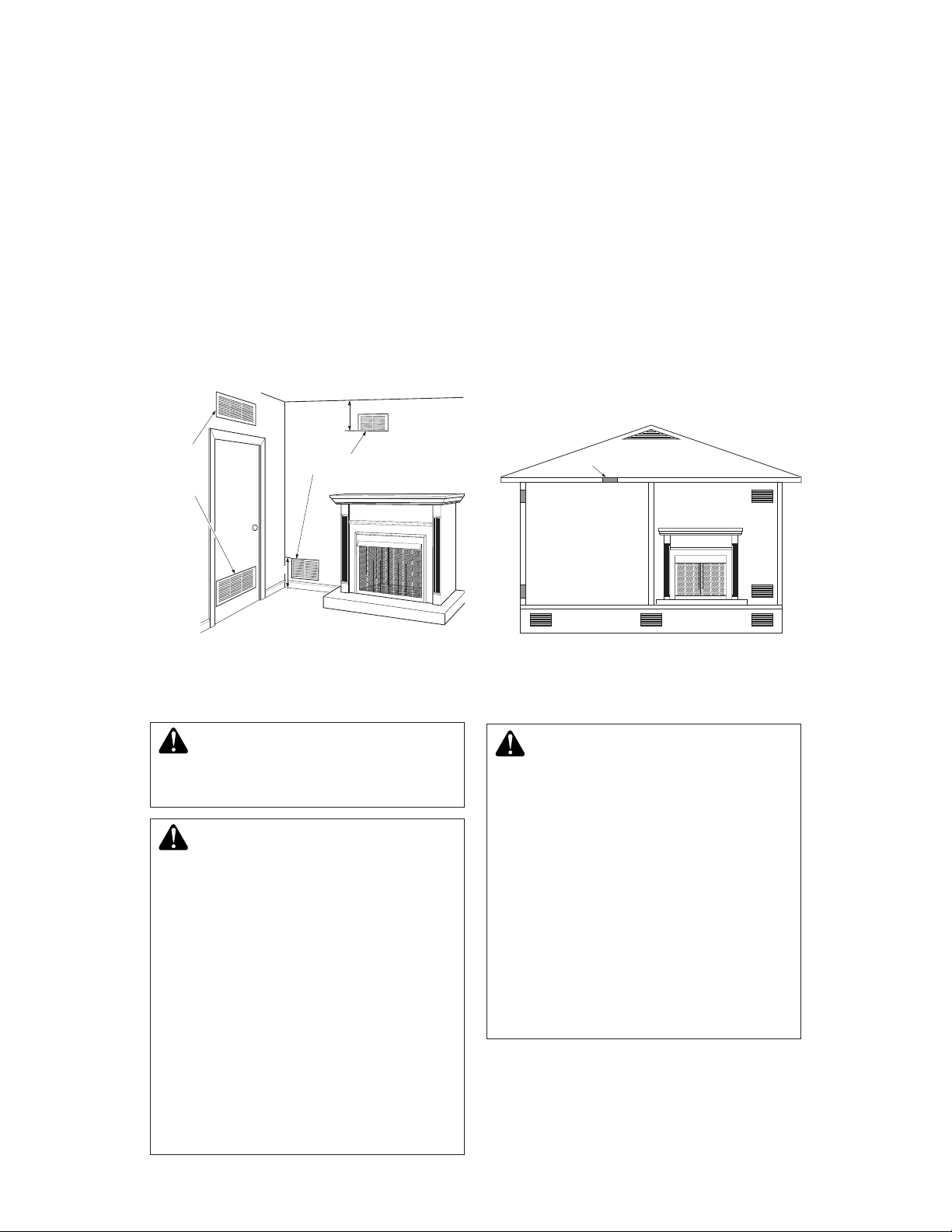
* Adjoining rooms are communicating only if
therearedoorlesspassagewaysor ventilation
grills between them
.