enough to avoid audible pump up, but as close as possible to the point where
pumping becomes audible. If the acutal setting causes no pumping, increase
the release time a little (to .6 or .8 sec). If there is still no pumping add gain
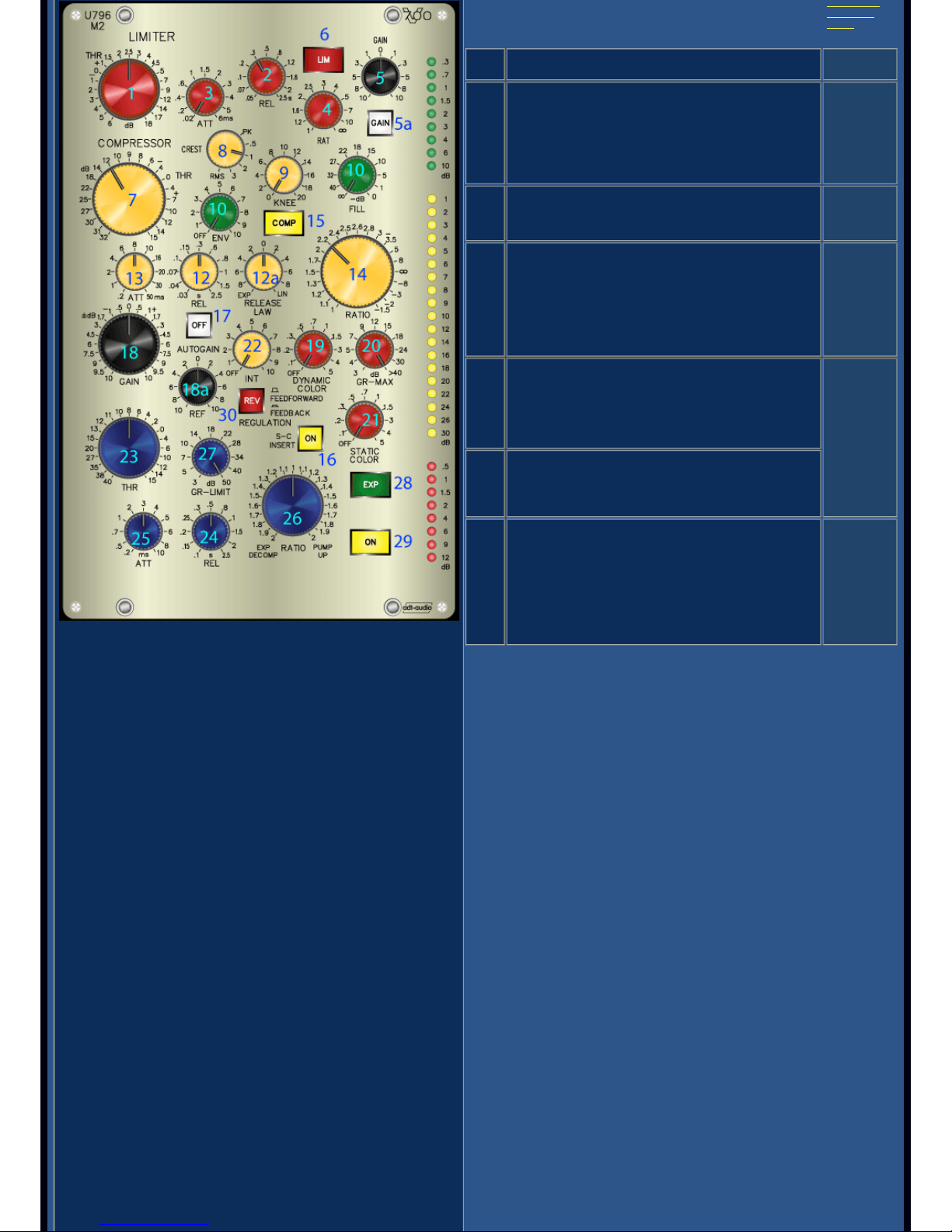
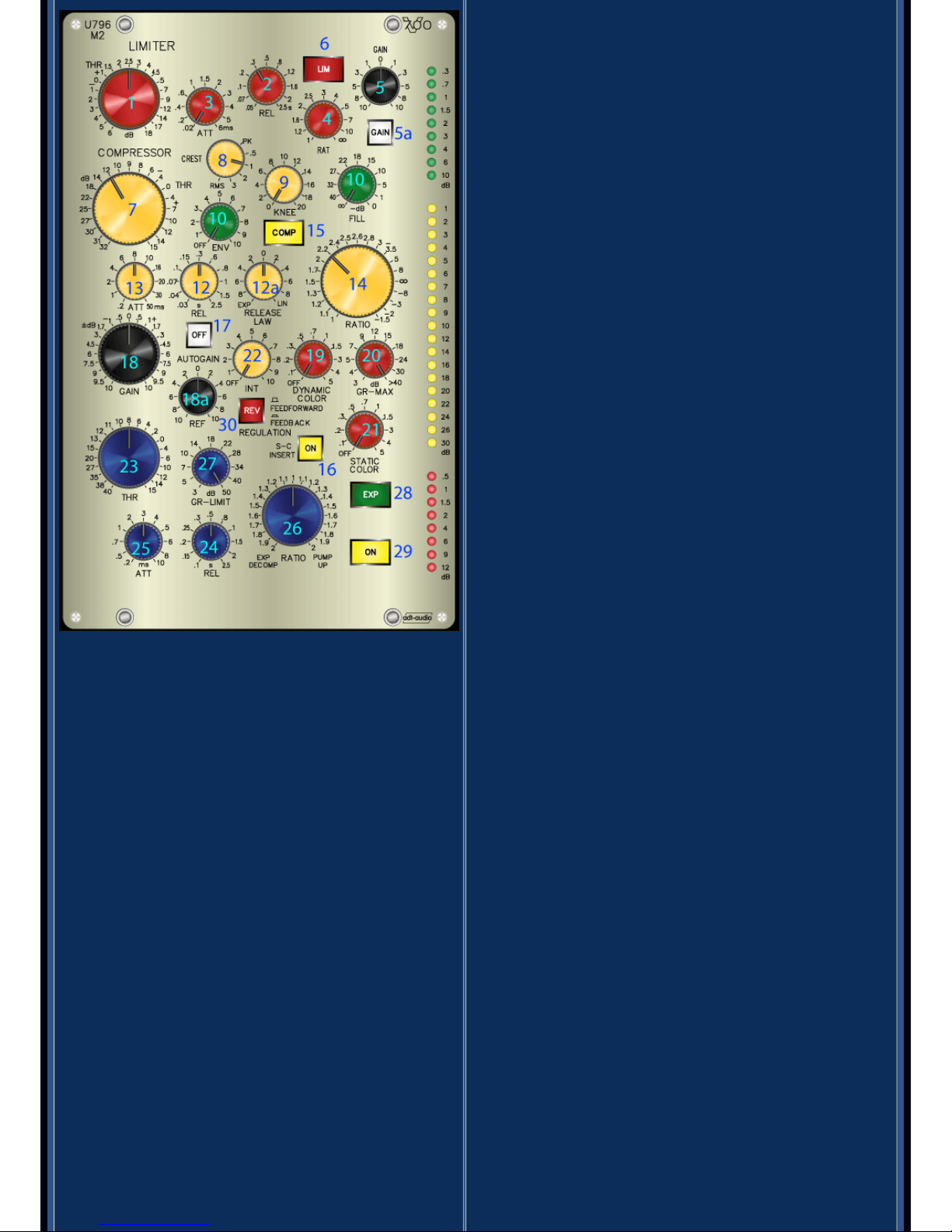
reduction by turning the Threshold control (7) one or more clicks to the left. As
soon as you hear pumping reduce the release time (12) and find the point
when pumping dissappears.
e) It is most likely that you will have low frequency distortion after fine tuning
the release control (12). If not, use the Treshold control (7) and increase the
gain reduction until you can hear LF distortion coming up. If you had to change
the Threshold setting (7), check again for pumping and readjust the release
control (12) if pumping is audible. (Just repeat step d in this case)
f) Open the Envelope control (11) until the low frequency distortion disappers.
g) Check the setting and compare the achieved loudness gain by switching the
compressor in and out (15). Make sure that the levels of the compressed and
the uncompressed signal are identical. Most of the gain reduction will be
compensated by the autogain circuitry. If there is still a difference, use the Gain
control (18) to adjust matching levels.
h) Try to fine-tune the setting by repeating the steps above, if you are not
satisfied with the result.
i) You can now try to achieve a higher gain reduction, either by setting the
Threshold control (7) more to the left, or by setting the ratio control (14) more
to the right. A higher gain reduction will always bring up some negative side
effects. At this points the main problem will be the 'demolition' of the signal
structure due to the high gain reduction. Use the Fill control (11) and add the
uncompressed input signal to cover the demolition. Focus on the fine structures
of the signal and find a setting that restores the original without affecting the
compression too much. If the Fill control (11) is wide open, you will loose
loudness gain. Fill is a powerfull tool to achieve higher gain reduction without
typical compressed sound.
j) You will now have a strong, but still good sounding compression with high
loudness gain. However, the short release time that is necessary to avoid
pumping will also result in a behavior that is 'tight and close to the signal'. Its
about time to put some 'air' into it. Open the Int control (22) carefully. Int adds
a long time integration modulation to the regulation. An additional control
circuit generates a control signal from the envelope of the input signal, using
long attack and release times. The Int control (22) adds this signal to modulate
the release time. The release time changes a little as soon as the average
loudness of the input signal is different. This makes the compression less tight;
the mix sounds more natural. If you add too much Int, you will loose loudness,
since the total release time is too slow to drive up the gain after peaks. The
goal of using Int is to maintain loudness, but get rid off the tightness. Try to
find this compromise.
ATTENTION: Int is a long time integration; the reaction on the setting is
very slow! Change the setting in little steps and wait several seconds for
the result before you change again. If you need to turn the control to left, it
is a lot faser to turn the pot all to left for a second and than go to the new
setting. This causes a reset to the circuit.